Climate policy
What Antalya delivered: COP31 in review
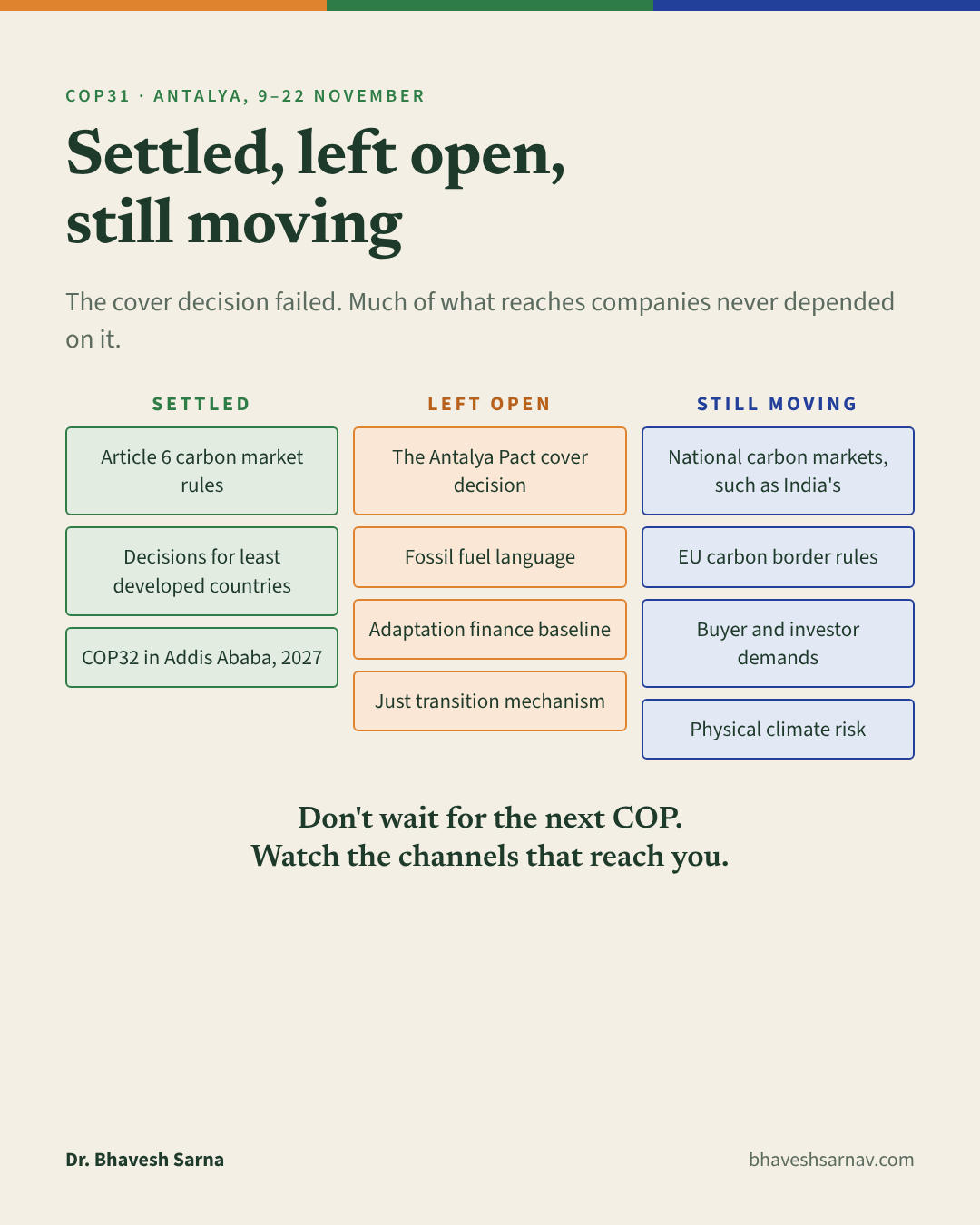
The 'implementation COP' ended without its main deal. But implementation was never going to happen in a conference hall. For companies, the channels that matter are still moving.
Before COP31 opened, I wrote that Antalya was being called the “implementation COP”, and that the real question was whether old promises would turn into rules, budgets and projects.
The conference was scheduled to end on 20 November. It ran two extra days and then ended without its main political text. In this post I look at what was decided, what was not, and what it means for companies, especially in India and Europe.
What happened at the end
The Turkish presidency had prepared a cover decision, the “Antalya Pact”, meant to sum up the conference. Over the final week, successive drafts dropped the reference to transitioning away from fossil fuels that countries had agreed in Dubai two years ago.
That split the room. Some countries refused any text that mentioned fossil fuels. The EU, Panama, the Marshall Islands and others refused a text that did not. After a fourth draft on Sunday 22 November, the Australian President of Negotiations, Chris Bowen, spoke of “unbridgeable divides”, and no cover decision was adopted (Brit Brief; Forbes).
It is important to be precise about what this means. The earlier commitments still stand, including the Dubai language on fossil fuels and the Paris Agreement itself. What failed was the attempt to add a new political package on top of them.
What was settled
Some decisions were adopted before the final deadlock.
Carbon markets. Decisions on Article 6 of the Paris Agreement, the rules for international cooperation and carbon trading, were adopted. For countries building carbon markets, including India, this matters more than the headlines suggest.
Least developed countries. Decisions on matters relating to the least developed countries were also adopted.
The next host. Ethiopia will host COP32 in Addis Ababa in 2027.
What was left open
Adaptation finance. The drafts kept the pledge from Belém to at least triple adaptation finance by 2035. But an earlier draft’s figure of US$120 billion a year was dropped, and the question of the baseline was passed to a technical report due in November 2027. Developing countries, especially in Africa, left Antalya without the clarity they asked for.
The just transition mechanism. Countries still disagree on what the mechanism should do and how it should be governed. The work continues next year.
Fossil fuels and electrification. The presidency promoted a goal of raising electricity’s share of final energy use to 35% by 2035, from about 23% today. It did not become an agreed outcome of the negotiations. It now stands as a voluntary aspiration that countries and companies can choose to support.
The unfinished items now move either to a resumed session in Bonn or to COP32 in Addis Ababa.
Why companies should not read this as “nothing changed”
It is tempting to conclude that a failed COP means a quiet year for business. I think that would be a mistake.
In my earlier post I described four channels through which climate pledges reach companies: national rules, public budgets, projects and buyer requirements. Almost none of them waited for Antalya.
National rules keep moving. India’s carbon market is in its first real compliance cycle, with trading expected from early 2027. Europe’s carbon border mechanism is in force. Neither depends on a cover decision.
Carbon markets got clearer, not weaker. The Article 6 decisions add to the rules for international carbon trading. For Indian firms that may one day sell credits abroad, or for European buyers looking for credible credits, this is a practical step.
Buyers and investors still ask. The questions arriving at suppliers about emissions, materials and due diligence come from company targets, investors and laws, not from the wording of a COP text.
Physical risk does not negotiate. Heat, floods and water stress will affect factories in India and elsewhere whether or not countries agree on adaptation finance. If anything, the lack of a clear finance path means companies should plan for adaptation on their own terms. I wrote about this for Indian factories earlier this week.
What I take from Antalya
Antalya showed again that the hardest questions in climate policy are not technical. They are about who pays, who changes and who gives something up. Those questions were not settled. They were postponed, and postponed problems usually become more expensive.
For managers, my advice is simple. Do not wait for the next COP to tell you what to do. Watch the channels that actually reach your business: your national rules, your buyers, your lenders and your own exposure to climate risk.
I would like to hear from readers: did the outcome of COP31 change anything in your organisation’s plans, or was it business as usual?