Climate adaptation
Heat, floods and water stress: adaptation is now a business problem for Indian factories
Climate talks treat adaptation as a matter for governments. On an Indian factory floor in May, it is a matter of absent workers, defective products and missed orders.
At climate conferences, adaptation is usually discussed as a question for governments: who pays for flood defences, how to protect farmers, how to measure progress. At COP31 in Antalya, adaptation indicators and adaptation finance were again among the main topics.
These are important questions. But on an Indian factory floor in May, adaptation looks very different. It looks like workers fainting at their machines, products failing quality checks because of heat, machines overheating, and power cuts during peak demand.
In this post I argue that adaptation is no longer only a public policy issue. For many Indian companies, it is already a business problem, and it should be managed like one.
The cost is already visible
Recent research makes the scale clear.
A study by IIED, published in July, estimated that extreme heat cost Indian workers about US$78 billion in lost wages in 2024, close to 2% of India’s GDP. It found that workers in indoor sectors such as garment manufacturing and food packaging lose around 15 working days a year to heat. In outdoor work like construction, it is about 24 days (IIED).
In garment factories, managers surveyed for a New York University Stern Center report estimated that productivity fell by 3–10% during peak summer months. They also reported more absenteeism, more product defects, and overheating equipment (Reuters, via Kuwait Times).
These figures matter for business. India’s garment industry aims to more than double exports by 2030. A sector that loses a tenth of its productivity every summer will find that goal much harder to reach.
Three climate risks on the factory floor
Heat is the most visible risk, but not the only one.
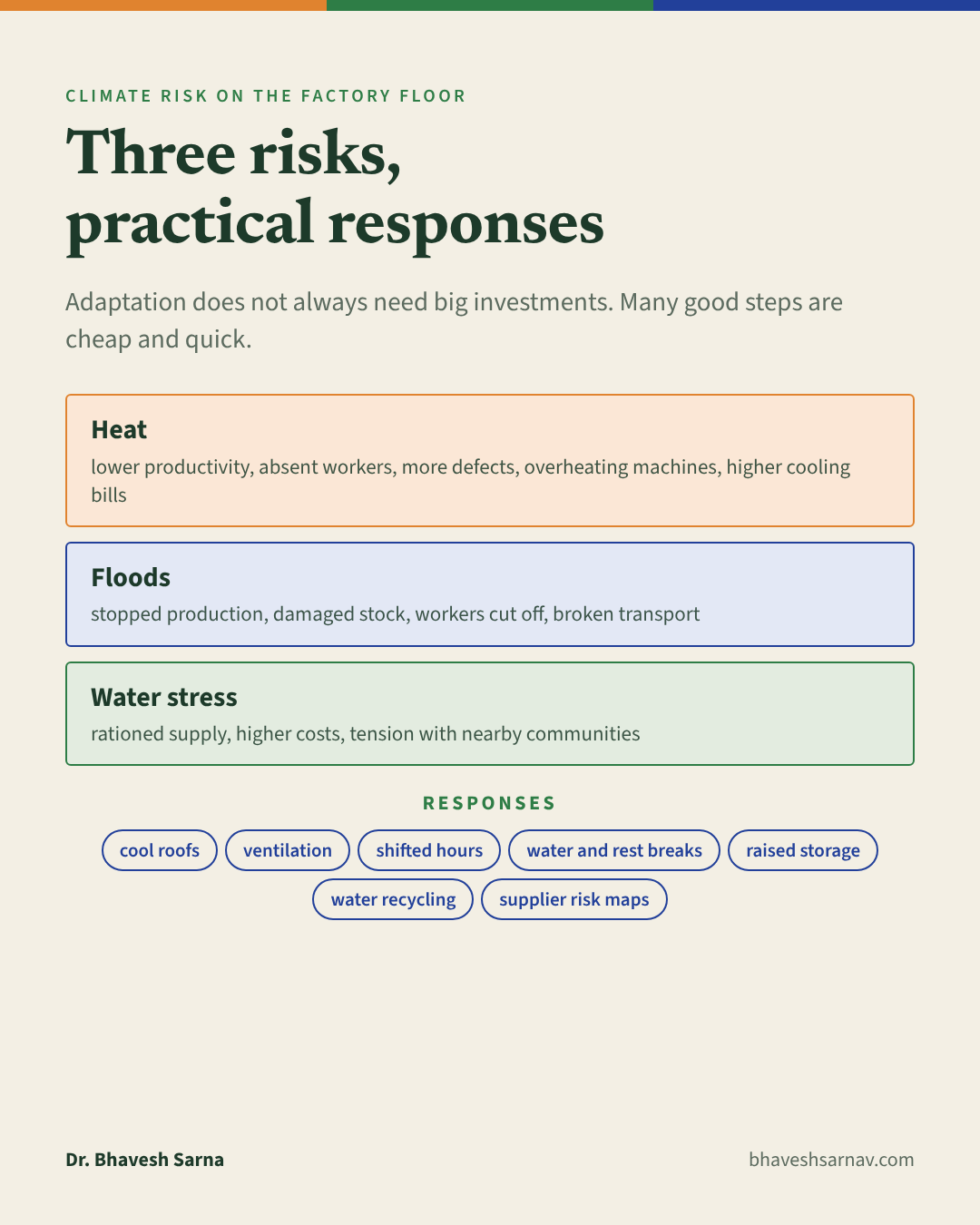
Heat reduces productivity, increases health risks for workers, damages heat-sensitive materials and equipment, and drives up electricity demand for cooling, often when the grid is most stressed.
Floods disrupt production and transport, damage stock and machinery, and cut off workers from the factory. Many industrial areas sit in low-lying zones that flood more often as monsoon rainfall becomes more intense.
Water stress threatens industries that need large volumes of water, such as textiles, food processing, chemicals and power. In several Indian states, factories already compete with cities and farms for groundwater.
Why smaller firms are most exposed
Large factories can install cooling systems, monitor temperatures, and move production between sites. Many small and medium firms cannot.
Most of India’s workforce is informal, without paid sick leave or social security. When a worker misses days because of heat illness, they lose income. When the factory loses output, it often makes up for it with longer shifts and overtime, which increases heat exposure further. It is a vicious circle.
There is also a supply chain dimension. A small supplier hit by a flood or a heatwave can stop the production of a much larger buyer. Adaptation is not only a question for each factory. It is a question for the whole value chain.
What companies can do
Adaptation does not always need large investments. Many effective steps are practical and affordable.
For heat: - Improve ventilation and use cool or reflective roofing, which can reduce indoor temperatures significantly. - Shift working hours to cooler parts of the day during peak summer. - Provide drinking water, shaded rest areas and regular breaks, and train supervisors to recognise heat illness. - Monitor indoor temperatures, so decisions are based on data, not guesses.
For floods: - Raise critical equipment and storage above likely flood levels. - Plan for alternative transport routes and temporary storage. - Keep emergency plans and contacts up to date before the monsoon.
For water: - Measure water use per unit of product, and set targets to reduce it. - Recycle process water where possible. - Understand the water situation of the local community, and avoid becoming the reason a village runs dry.
Across the value chain: - Map which suppliers are in high-risk locations. - Talk to buyers about realistic schedules during extreme heat, instead of pushing workers harder.
A role for buyers
This last point deserves attention. In the same Reuters report, an Indian heat expert said she had not seen brands or buyers adjust production schedules or targets because of heat.
That is a gap. Buyers who expect suppliers to report emissions, labour standards and recycled content should also recognise that climate impacts are already affecting the people who make their products. Flexible delivery schedules during heatwaves, support for cooling investments, and shared risk planning would be meaningful steps.
Adaptation as part of sustainability strategy
For a long time, corporate sustainability focused on mitigation: reducing a company’s own emissions. That remains essential. But the climate is already changing, and companies need to prepare for what is coming as well as reduce what they cause.
In practice, this means treating heat, floods and water stress as business risks, measured and managed like any other. It also means remembering that the first people affected are workers, often the least protected.
I would like to hear from readers who run or work in factories: what has your workplace done to cope with extreme heat, and what worked?