CSR
Twelve years of mandatory CSR in India: what Europe can learn from Section 135
India made companies spend on social responsibility. Europe made them report. After twelve years, India's experiment has lessons for anyone who believes rules can make business behave better.
In April 2014, India did something no other large economy had done. It made corporate social responsibility a legal duty.
Under Section 135 of the Companies Act, 2013, large companies must spend at least 2% of their average net profit from the previous three years on social projects. The rule covers companies with a net worth of ₹500 crore or more, a turnover of ₹1,000 crore or more, or a net profit of ₹5 crore or more.
Twelve years later, the amounts are large. In 2024–25, Indian companies spent a record ₹40,794 crore on CSR, according to the Bharat CSR Performance Report 2026. That is about 17% more than the year before, from close to 30,000 companies.
I have followed Section 135 since my doctoral research on how employees relate to their company’s CSR. In this post I look at what the law has achieved, where it struggles, and why Europe, which chose a very different path, should pay attention.
Two ways to make business responsible
When governments want companies to take more responsibility for society, they have broadly two options.
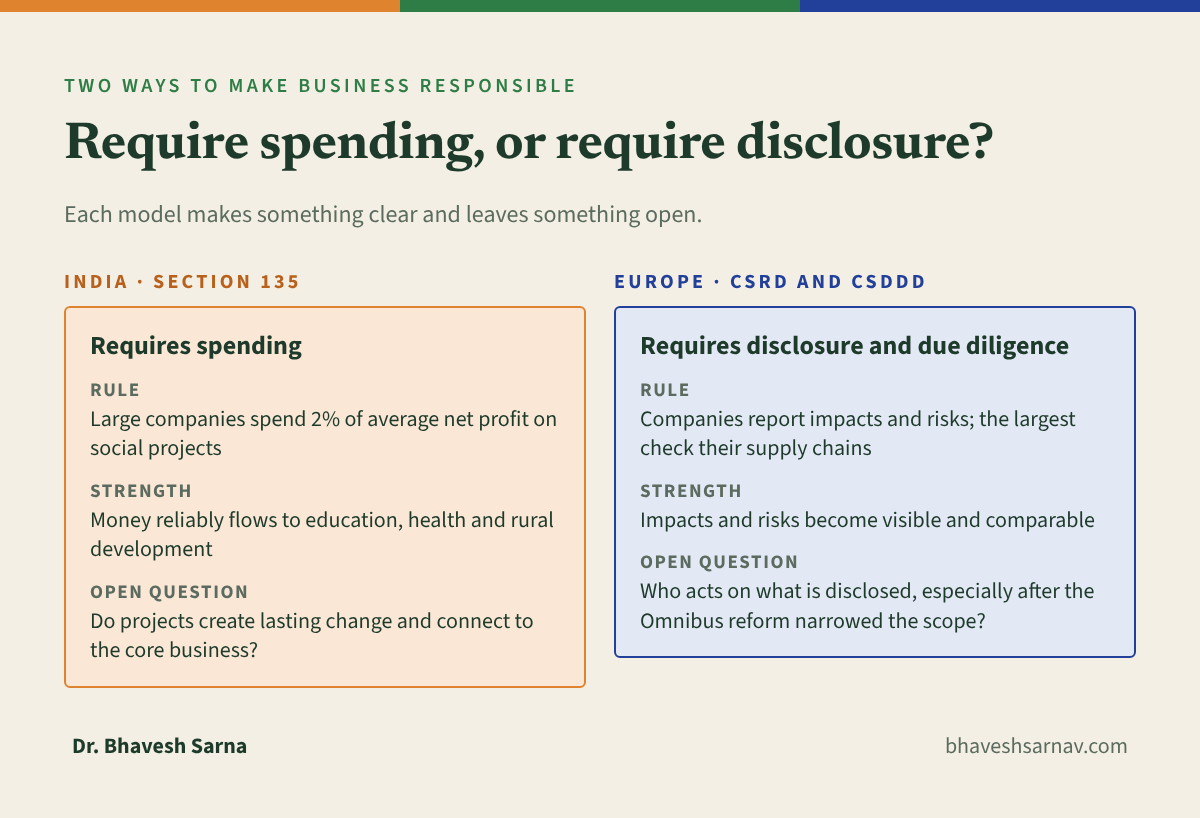
They can require action: tell companies what to do or spend. India chose this with Section 135.
Or they can require transparency: tell companies to disclose their impacts and risks, and let investors, customers and civil society push for change. Europe chose this with its sustainability reporting directive (CSRD), and added a due diligence duty (CSDDD) for the largest firms.
Each model makes something clear and leaves something open.
What India’s experiment achieved
The first achievement is scale. Before 2014, CSR in India depended on the goodwill of a few large business families and companies. Now, money flows every year, from tens of thousands of firms, into education, health, rural development and other areas listed in the law. Education alone received close to 34% of spending last year, and health about 21%.
The second achievement is professionalisation. Companies built CSR teams, foundations and partnerships with NGOs. A whole sector of implementing agencies, auditors and consultants grew up around the law.
The third achievement is enforcement. Early on, companies could “comply or explain”: if they did not spend, they could simply give reasons. From 2021, the rules became stricter. Unspent money must now be moved into special accounts or government funds, with penalties for failure. The law moved from encouragement to obligation.
Where it struggles
The weaknesses are just as instructive.
Geography. Money tends to go where companies already are. Maharashtra received the most CSR funds last year. Poorer states with fewer large companies receive much less, even though their needs are greater.
Box-ticking. When spending becomes a legal duty, the easiest goal is to spend the right amount, on time, on an eligible activity. Whether the project changes anything becomes secondary. Many companies report how much they spent far more clearly than what it achieved.
Distance from the core business. Section 135 asks companies to spend part of their profit. It does not ask how they make that profit. A company can fund a school while polluting a river next to its plant. In this sense, the law is closer to compulsory philanthropy than to responsible business.
Inside the company. This is where my own research comes in. When CSR becomes a legal task, it often arrives inside the company as one more job to be done. Some employees see it as meaningful. Others see it as paperwork that someone in head office has to finish before the year ends. The law can buy projects. It cannot, on its own, buy commitment.
Lessons for Europe
Europe’s model is very different, but it faces similar risks. Three lessons stand out to me.
- Mandates create compliance, not always change. India shows that a clear rule will be followed. It also shows that companies will meet the rule in the cheapest acceptable way. European reporting faces the same risk: thick reports that meet every standard but change little in practice.
- What gets measured gets managed, so measure the right thing. India measures spending. Europe measures disclosure. Neither measures outcomes well. Both systems would gain from asking more often, “what changed because of this?”
- Rules work through people. A law reaches society only through managers, employees and partners who carry it out. If they experience it as a burden, the outcome will be thin. Designing rules that people can believe in matters as much as designing rules that can be enforced.
What India can learn in return
The learning goes both ways. Europe’s focus on the core business, on supply chains and on real impacts, is exactly what Section 135 lacks. India’s own reporting framework, BRSR, already moves in this direction for large listed companies. The interesting question for the next decade is whether India can connect its spending law and its reporting law, so that companies are asked not only how much they give, but how they earn.
An unfinished experiment
Twelve years is a short time for a law of this size. Section 135 is neither the failure its early critics feared nor the model its supporters hoped for. It is a large, unfinished experiment, and the world can learn from it.
As Europe recalibrates its own rules, it would do well to look east. And as India refines its law, it could look west. I would like to hear from practitioners on both sides: in your experience, what makes a mandatory sustainability rule produce real change rather than paperwork?