Circular economy
Europe's Circular Economy Act: what it could mean for suppliers outside Europe
Europe wants to double its use of recycled materials by 2030. If it succeeds, suppliers in India and Asia will face new demands on recycled content, product design and material data.
While Europe has been cutting back its sustainability reporting rules, it has been preparing a new law in a different area: the circular economy.
The European Commission’s Circular Economy Act was scheduled for this autumn, with the proposal expected in November 2026 (EUWID). After the Commission presents it, the European Parliament and the member states must agree on the final text, which usually takes one to two years. Details will change on the way.
Most commentary on the act is written for European recyclers and manufacturers. In this post I look at it from the other side: what it could mean for suppliers in India and elsewhere in Asia who sell into European value chains.
Why Europe wants this law
The numbers explain the motivation. Only about 12% of the materials used in the EU come from recycled sources, and that figure has barely moved for years. The EU’s goal is to double it, to 24% by 2030 (European Parliament briefing).
There is also a security argument. Europe depends heavily on imported raw materials, including critical minerals for batteries and electronics. Recycling more of what it already has reduces that dependence. The circular economy has moved from an environmental idea to an industrial strategy.
What the act is expected to contain
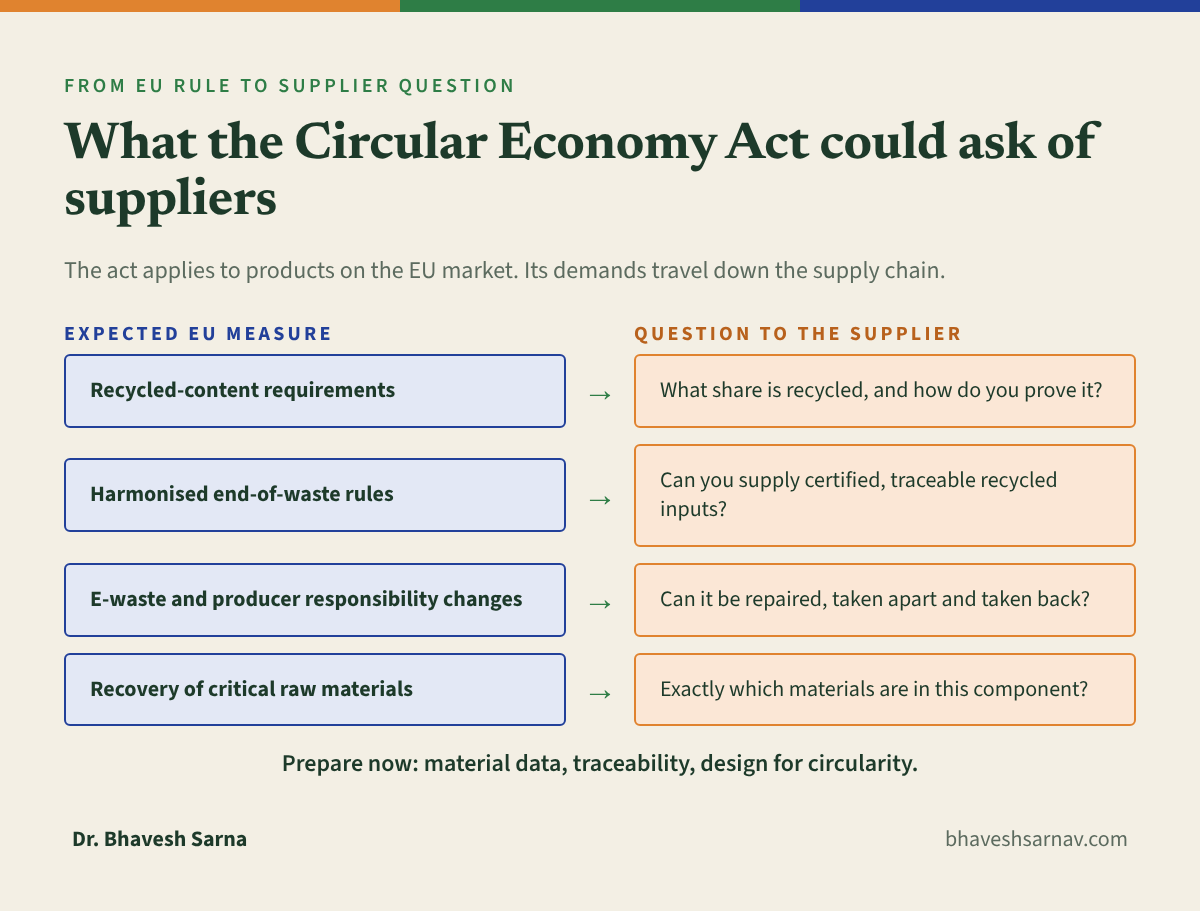
Based on the Commission’s preparatory work and the European Parliament’s briefing, the main building blocks are:
- A single market for secondary raw materials. Today, each member state has its own rules on when waste stops being waste. The act aims to harmonise these “end-of-waste” rules so recycled materials can move freely across the EU.
- Changes to waste and e-waste law. The act is expected to amend the Waste Framework Directive, the Landfill Directive and the e-waste (WEEE) Directive. E-waste recycling in the EU is around 31%, far below the target.
- More demand for recycled materials. Recycled-content requirements and green public procurement are among the tools under discussion to make sure recycled materials actually get used.
- Recovery of critical raw materials from waste, such as rare earths from electronics and magnets from electric vehicles.
- Better producer responsibility schemes, with more harmonised rules for companies that place products on the EU market.
How it reaches suppliers outside Europe
The act will apply to products placed on the EU market, not to factories in India or Thailand. But that distinction matters less than it seems. When a European brand faces a rule, it passes the requirement down its supply chain. I described the same pattern for reporting rules in a recent post.
I expect four kinds of questions to reach suppliers.
1. “How much recycled content is in this?” If recycled-content requirements are set for certain products or materials, buyers will need to know the share of recycled material in what they buy, and they will need proof. Simple claims will not be enough. Certification and traceability will matter.
2. “Can you supply certified recycled inputs?” As end-of-waste rules become clearer, demand for recycled plastics, metals and fibres of known quality will grow. Indian recyclers who can meet European quality and documentation standards may find new markets.
3. “Can this product be repaired and taken apart?” Changes to e-waste rules and producer responsibility will push European brands to design products that last longer and are easier to repair and recycle. Component suppliers will be asked to support that design.
4. “What exactly is in this?” Recovering critical raw materials needs detailed knowledge of material composition. Buyers will ask suppliers for more precise data on materials and substances.
Risk and opportunity for India
For Indian suppliers, the act brings both.
The risk is familiar: another layer of questions, documentation and costs, arriving on top of carbon border rules and supply chain due diligence. Small firms, again, will find it hardest.
The opportunity is real too. India has one of the world’s largest recycling and repair economies, much of it informal. If parts of that system can meet European standards for quality and traceability, India could become a major supplier of secondary raw materials and recycled inputs. That would require investment, formalisation and better working conditions in the recycling sector, but the market signal from Europe could help pay for it.
India has also been building its own producer responsibility rules for plastics, batteries, tyres and e-waste. A supplier that already complies with Indian rules is better prepared for European expectations than one starting from zero.
What suppliers can do now
The law is not final, so this is the time to prepare, not to panic.
- Know your materials. Start recording what goes into your products, including any recycled content, and where it comes from.
- Ask your buyers. European customers are already thinking about the act. Ask them what they expect to need from you in two or three years.
- Look at certification. If you use or supply recycled materials, find out which certification schemes your buyers trust.
- Design with your customers. If you make components, offer to work with buyers on designs that are easier to repair, disassemble and recycle. Early cooperation builds stronger relationships.
The direction is clear
Europe’s reporting rules have been softened, but its push for a circular economy is getting stronger. For suppliers outside Europe, the questions are shifting from “what are your emissions?” to “what is your product made of, and what happens to it at the end?”
I would like to hear from suppliers and recyclers: are European buyers already asking you about recycled content or design for repair?