Climate policy
COP31 in Antalya: why this is the 'implementation COP', and what to watch
Antalya is not about new promises. It is about whether the old ones turn into rules, budgets and projects. That is where companies will feel it.
Next Monday, the UN climate conference opens in Antalya, Türkiye. COP31 runs from 9 to 20 November at the Antalya Expo Center. The leaders’ segment is on 11 and 12 November.
This COP has an unusual set-up. Türkiye is the host and holds the presidency. Australia leads the formal negotiations. That split is new, and it will be interesting to see how well it works under pressure.
Many observers call Antalya the “implementation COP”. The phrase sounds dull, but I think it is the most important idea to understand this year. In this post I explain what it means, which talks to follow, and why companies, not only governments, should pay attention.
From promising to proving
For ten years after Paris, climate conferences were mostly about targets. Countries announced goals. Others asked for higher goals. The news was about numbers for 2030, 2035 and 2050.
That phase is not over, but it has slowed. According to Carbon Brief, about 150 parties have now submitted new national climate plans (NDCs), covering roughly three-quarters of global emissions. The question in Antalya is less “what is your target?” and more “how will you get there, and who pays?”
This is a harder question. A target is a promise. Implementation means laws, budgets, permits, prices and projects. It also means someone carries a cost that was easy to ignore while the plan was only on paper.
Five things to watch in Antalya
1. Money. Finance is again at the centre. At COP29 in Baku, countries agreed a new finance goal. Developing countries now want a proper work programme to make sure the money arrives, and they push developed countries to provide more public funds. Developed countries prefer to talk about better access to existing funds and a wider group of donors. Expect long nights on this.
2. Adaptation. At COP30 in Belém, countries agreed a list of 59 indicators to track the global goal on adaptation, and a pledge to at least triple adaptation finance for developing countries by 2035. The talks in Bonn in June did not settle the details. In Antalya, the question is whether the indicators become something useful, and whether the tripling pledge gets a clear path. Heat, floods and water stress are no longer future risks for India or for Southern Europe. They already affect factories, farms and cities.
3. A just transition. Belém also agreed to set up a mechanism for a just transition, now called the Belém–Antalya mechanism. Many details are missing. Parties still disagree on its scope and whether it should be linked to finance. This matters for coal regions, for workers in heavy industry, and for every country that must change its energy system without leaving people behind.
4. The second global stocktake. COP31 starts the second global stocktake, which runs until 2028. This is the Paris Agreement’s own review of whether the world is on track. It sets the tone for the next round of national plans.
5. The action agenda. The Turkish presidency has named ten priority themes for its action agenda, including clean energy, climate-resilient cities, green industrialisation, food security and oceans. Australia hopes for a broader “cover text” that could include targets such as electrification. Whether that happens depends on politics in the room.
Why companies should care
Many managers see COPs as diplomatic events with little effect on business. I understand this view, but I think it is wrong this year.
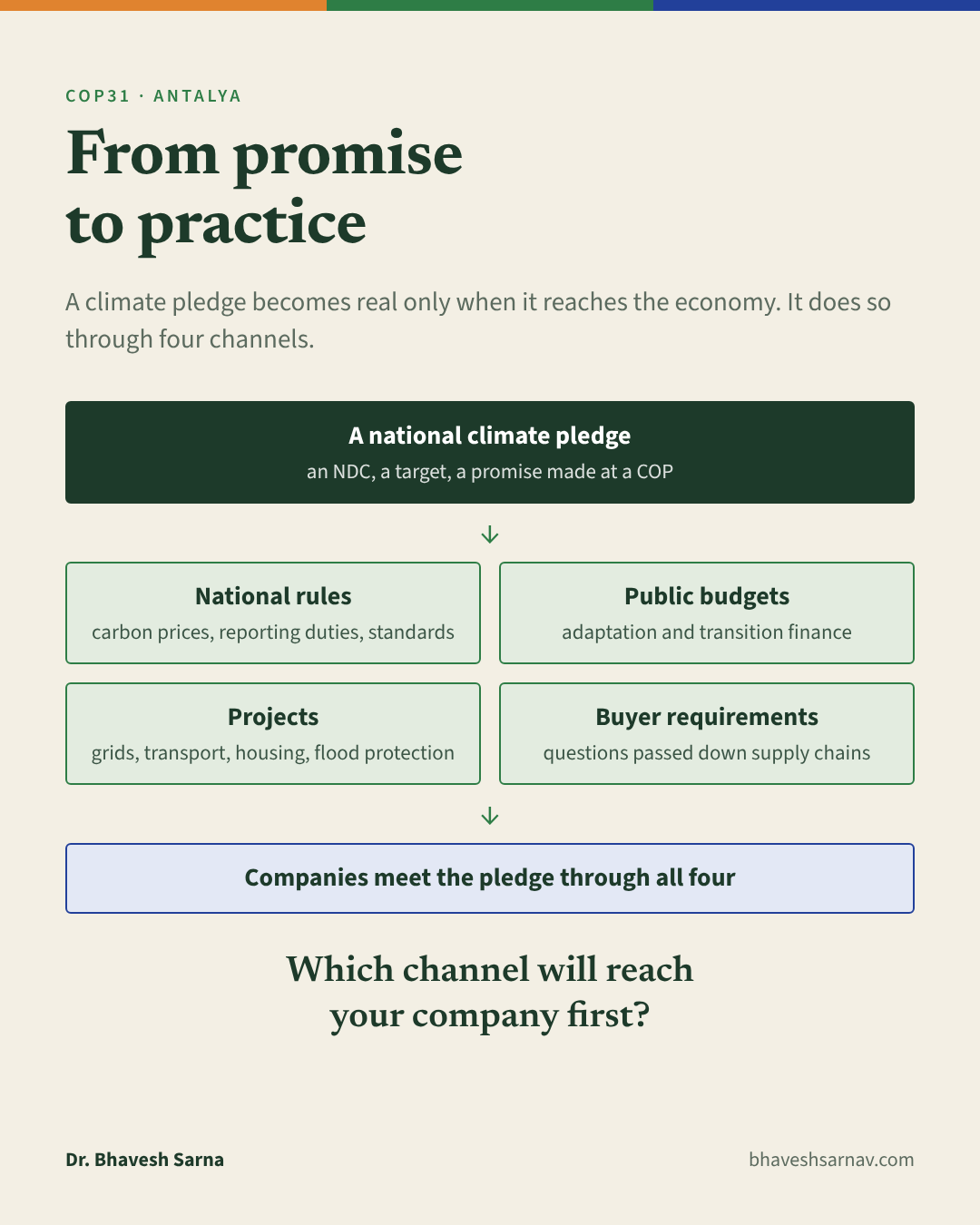
When a pledge becomes implementation, it reaches companies through a few clear channels:
- National rules. India’s carbon credit trading scheme and its BRSR reporting rules are examples. So are Europe’s emissions trading and its carbon border tax. These are how national plans turn into prices.
- Public money. Adaptation and transition finance shape which projects get built, from grids to flood protection. They also create markets for the firms that build them.
- Buyer requirements. Large companies that face rules pass questions down their supply chains. A small supplier in Tamil Nadu or Tampere may feel a COP decision first as a customer questionnaire.
- Risk. Adaptation is not only a public matter. A factory that floods every second monsoon has a business problem, not only a climate problem.
So the useful question for a company is not “what did COP31 decide?” It is “which of these channels will reach us first, and are we ready for it?”
What I will watch as a researcher
My own interest is in what happens between a promise and its practice. Plans look clean when they are written. Tension appears when someone has to pay, change or give something up.
Antalya will show whether countries are ready to name those tensions openly. Who funds adaptation? Who carries the cost of moving away from coal? Who gets support, and who is left to manage alone? These questions are uncomfortable. But a conference that avoids them will only push them into the future, where they become more expensive.
I will write a short follow-up after the conference closes on 20 November, looking at what Antalya actually delivered.
Until then, a question for readers in business: which part of your country’s climate plan do you expect to reach your company first?