ESG reporting
Scope 3 questions are reaching Indian MSMEs: a starter guide
Your buyer's Scope 3 is your Scope 1 and 2. Here is what that means for a small Indian supplier, and how to answer the first carbon questionnaire without panic.
A growing number of small and medium Indian firms are receiving an email they did not expect. A European or Indian buyer asks for their carbon emissions. Sometimes it is a short form. Sometimes it is a long questionnaire full of terms like “Scope 1”, “Scope 2”, “emission factors” and “Scope 3 Category 1”.
For a small exporter with no sustainability team, this can feel overwhelming. It does not need to be. This guide explains, in plain language, why these questions are coming, what they mean, and how to give a good first answer.
Why your buyer is asking
Large companies are now expected to report not only the emissions from their own operations, but also the emissions in their supply chain. In many industries, the supply chain accounts for most of a company’s total footprint.
The pressure comes from several directions at once: European reporting and due diligence rules for the largest firms, the EU’s carbon border tax on steel, aluminium and other goods, India’s BRSR reporting for large listed companies (which now asks about the value chain), and voluntary climate targets that buyers have promised to investors.
So when a buyer asks you for data, it is usually because someone is asking them.
The three scopes, in one minute
Greenhouse gas reporting uses three “scopes”, defined by the GHG Protocol.
- Scope 1 is what you burn yourself: diesel in your generator, gas in your furnace, fuel in your company vehicles.
- Scope 2 is the electricity you buy. The emissions happen at the power plant, but they are counted as yours.
- Scope 3 is everything else in your value chain: what your suppliers emit to make your inputs, transport, business travel, how customers use and dispose of your product, and more. The GHG Protocol divides Scope 3 into 15 categories.
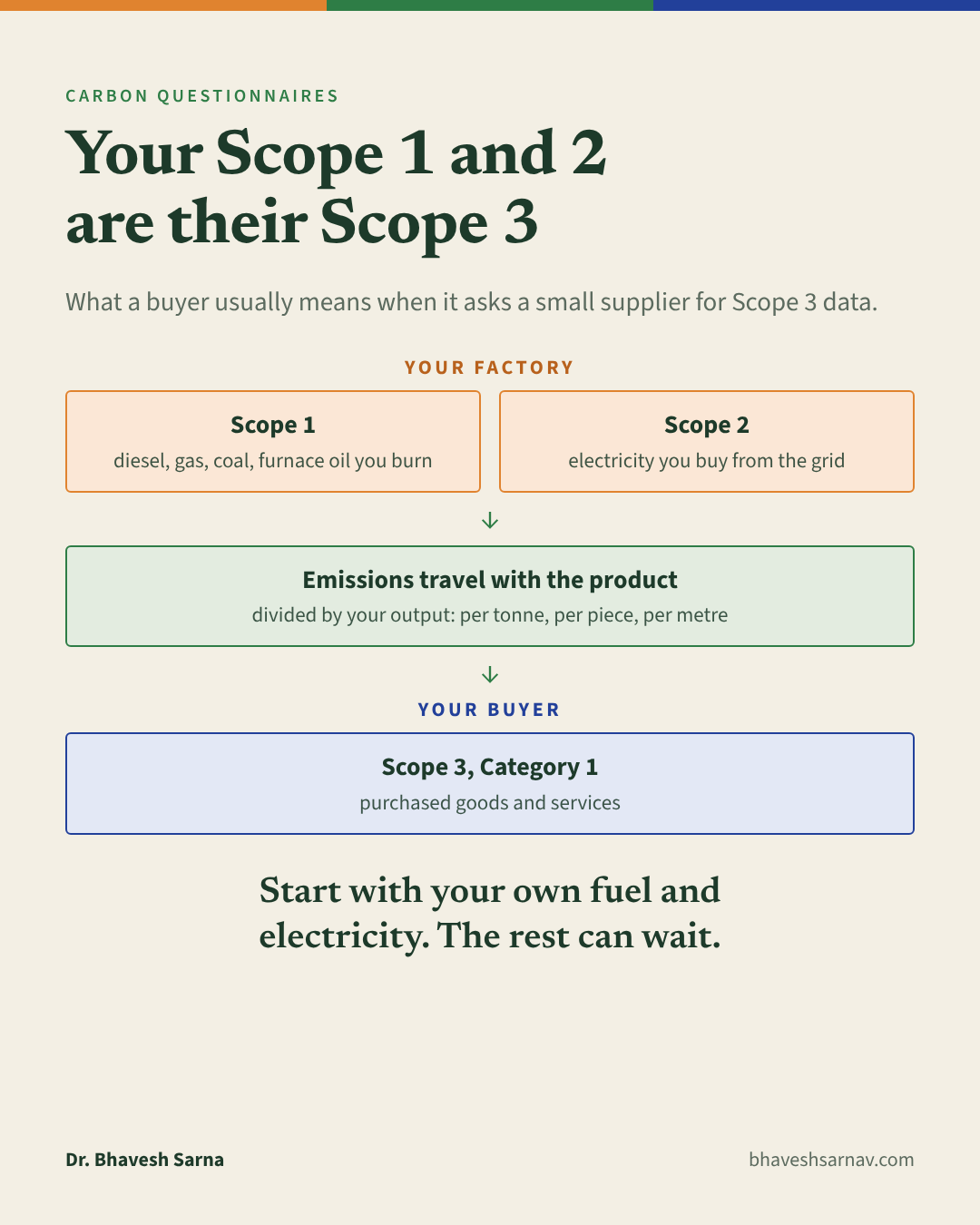
Here is the key point for a supplier: your Scope 1 and 2 are part of your buyer’s Scope 3. When your buyer asks for “Scope 3 data”, they usually mean your own fuel and electricity emissions, linked to the products you sell them.
A five-step starter plan
You do not need consultants or software to give a credible first answer. You need organised records and a simple method.
1. Collect twelve months of bills. Electricity bills, and purchase records for diesel, petrol, LPG, coal, natural gas or furnace oil. These are the core of almost every small firm’s Scope 1 and 2.
2. Convert to emissions. Multiply each quantity by a standard emission factor. For electricity, use the grid emission factor published by India’s Central Electricity Authority. For fuels, use published factors from the GHG Protocol or India’s national inventory. Note which factors you used and where they came from.
3. Add up Scope 1 and Scope 2. Keep them separate in your answer. Buyers need to see both.
4. Divide by output. Your buyer usually wants emissions per unit of what you sell them: per tonne, per piece, per metre of fabric. Divide your total by your annual production. If you make several products, start with a simple split by production volume or by energy use per line.
5. Write down your method. One page is enough: the period, the data sources, the emission factors, and how you allocated emissions to products. This page builds trust. A number without a method is easily doubted.
Common mistakes to avoid
- Guessing instead of measuring. A rough number from real bills is far better than a precise-looking number from nowhere.
- Mixing up units. Kilowatt-hours, litres and kilograms all need the right factor. Check every unit twice.
- Forgetting the generator. Diesel generators are a large source of emissions for many Indian factories, and they are often left out.
- Answering every questionnaire differently. Prepare one standard data sheet and send the same figures to every buyer. Consistency builds credibility.
- Promising targets you cannot meet. It is fine to say you are measuring for the first time. Commit to improving, not to an impossible number.
Turn the question into an advantage
Measuring emissions often reveals waste: a generator that runs too often, an old motor, a compressor that leaks. Many small firms find that the first carbon calculation pays for itself through lower energy bills.
There is also a commercial side. Buyers are starting to compare suppliers on carbon. A firm that can answer clearly and quickly, with a method behind its numbers, stands out from those who cannot. With Europe’s carbon border tax already in force for some goods, verified data may soon decide who keeps an order and who loses it. I wrote about this for steel exporters in a recent post.
Start small, start now
You do not need to calculate your full Scope 3 on day one. Start with your own fuel and electricity. Get the method right. Improve it each year. Later, you can begin asking your own suppliers the same questions.
I would like to hear from MSME owners and the people who advise them: what is the most confusing question you have seen in a buyer’s carbon questionnaire?