Regulation
Europe shrank its sustainability rules. What changes for suppliers in India and Asia?
After the Omnibus reform, far fewer European companies must report. But the questions that reach suppliers have not stopped. They have changed shape.
In early October I wrote about how the West is easing its sustainability rules while India starts to price carbon. This post looks at a narrower question, one that matters for thousands of supplier firms in India and elsewhere in Asia: will European buyers now stop sending sustainability questionnaires?
The short answer is no. But the questions will change, and some suppliers now have new rights they may not know about. This post explains what happened, and what it means for a supplier.
What the Omnibus reform changed
The EU’s Omnibus I directive was published in February 2026 and entered into force on 18 March. It cut back two major laws.
Reporting (CSRD). Only EU companies with more than 1,000 employees and more than €450 million in turnover must now report. Before the reform, the threshold was much lower, and tens of thousands of companies were expected to report. Most of them are now out of scope.
Due diligence (CSDDD). The duty to check human rights and environmental harm in supply chains now applies only to companies with more than 5,000 employees and €1.5 billion turnover. Member states have until July 2028 to put it into national law.
For a supplier, the first effect is simple. There are fewer European companies with a legal duty to ask about your emissions, labour practices or waste.
The new protection for smaller suppliers
The second change is less known, and in my view more important for suppliers.
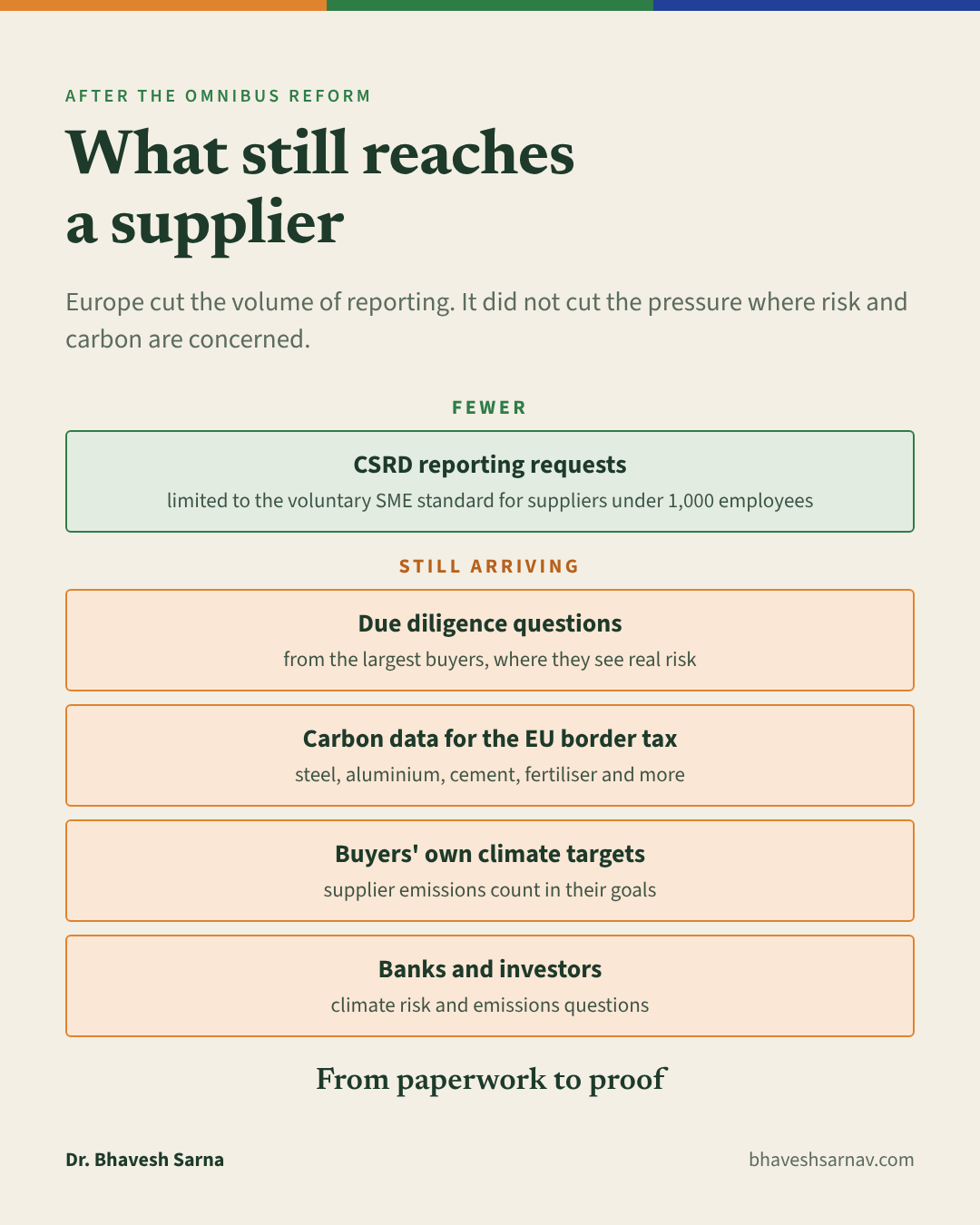
The reform added what is often called a value-chain cap. Suppliers with fewer than 1,000 employees are protected from unlimited data requests made for CSRD reporting. A reporting company should limit its requests to what is covered by the EU’s voluntary standard for smaller firms, known as VSME. If it asks for more, it must tell the supplier that the request goes beyond that standard, and that the supplier may decline (EcoVadis summary).
In plain terms: if you are a mid-sized supplier, a European customer can no longer bury you in a 300-question survey just for its sustainability report and expect a full answer.
This is a real relief. Over the past few years, questionnaire fatigue has become a common complaint among suppliers. Each buyer sent its own format. The same data had to be entered again and again. Small firms had no staff for it.
What still reaches suppliers
Before suppliers relax, it is worth looking at what the reform did not touch.
Due diligence from the largest buyers. The biggest European groups are still in scope of CSDDD. They must still identify and act on serious harms in their supply chains. The value-chain cap applies to reporting data, not to genuine risk management. A large buyer can still ask about forced labour, safety or pollution where it sees a real risk.
Carbon at the border. The EU’s Carbon Border Adjustment Mechanism was not softened. Importers of steel, aluminium, cement, fertiliser and some other goods need verified emissions data from their suppliers. I will write about this separately, because it hits small exporters hard.
Buyers’ own targets. Many large companies have climate targets that include their suppliers’ emissions. These targets were set voluntarily, often with investors watching. They do not disappear because a reporting law changed.
Banks and investors. Lenders in Europe and India increasingly ask about climate risk and emissions. These requests come from finance rules and from risk management, not only from CSRD.
So the pressure on suppliers is not going away. It is becoming more focused: fewer generic surveys, and more specific questions from buyers who face real risk or real regulation.
What a supplier should do now
Based on this, I suggest three practical steps for suppliers in India and elsewhere in Asia.
- Prepare one standard data pack. Build a short, clean set of data that matches the VSME standard: energy use, emissions, water, waste, workforce basics and key policies. Update it once a year. Send it to every buyer who asks. This turns a hundred different requests into one answer.
- Know your rights, and use them politely. If a request clearly goes beyond VSME for reporting purposes, you can ask the buyer whether it is required. Many buyers will be glad to simplify. Use this right to reduce workload, not to avoid real issues.
- Invest where the money is. If you export goods covered by the carbon border tax, or supply a very large European group, put your effort there first. Verified emissions data is becoming a commercial asset, not only a compliance cost.
A shift from paperwork to proof
Taken together, I read the Omnibus reform as a shift from paperwork to proof. Europe has reduced the volume of reporting. It has kept the pressure where carbon and serious harm are concerned.
For suppliers, that is mostly good news. Less time on forms means more time on real improvements. But it also means that when a question does come, it is more likely to matter.
I would like to hear from suppliers and buyers: since the reform, have the sustainability questions you receive or send become fewer, shorter or more focused?