Sustainability transitions
Desha, kala, patra: why sustainability ideas do not travel easily between Europe and India
An old Indian idea says that right action depends on place, time and person. It is also a useful test for any sustainability practice that moves between countries.
Every year, many good sustainability ideas travel between Europe and India. Policies are studied and borrowed. Business models are piloted. Universities run joint projects, and consultants carry slides from one country to the other.
Some of these ideas take root. Many do not. When they fail, the usual explanation is “implementation problems” or “culture”. Both explanations are too vague to help anyone.
I have worked between Finland and India for more than a decade, in research, teaching and international projects. Over time, I have found an old Indian idea more useful than most modern frameworks for understanding why practices travel well or badly. It is called desha, kala, patra.
An old idea for a modern problem
In classical Indian thought, desha, kala and patra are three conditions for judging right action. Desha means place. Kala means time. Patra means the person, or more literally the vessel: the one who receives and carries the action.
The point is simple but deep. An action that is right in one place, at one time, for one person, may be wrong in another. Wisdom is not only knowing the rule. It is knowing when, where and for whom the rule fits.
This is not relativism. The goal stays the same. What changes is how you reach it.
Sustainability work needs exactly this kind of thinking. The goal, a liveable planet with fair economies, is shared. But the practice that serves this goal in Helsinki may not serve it in Hyderabad.
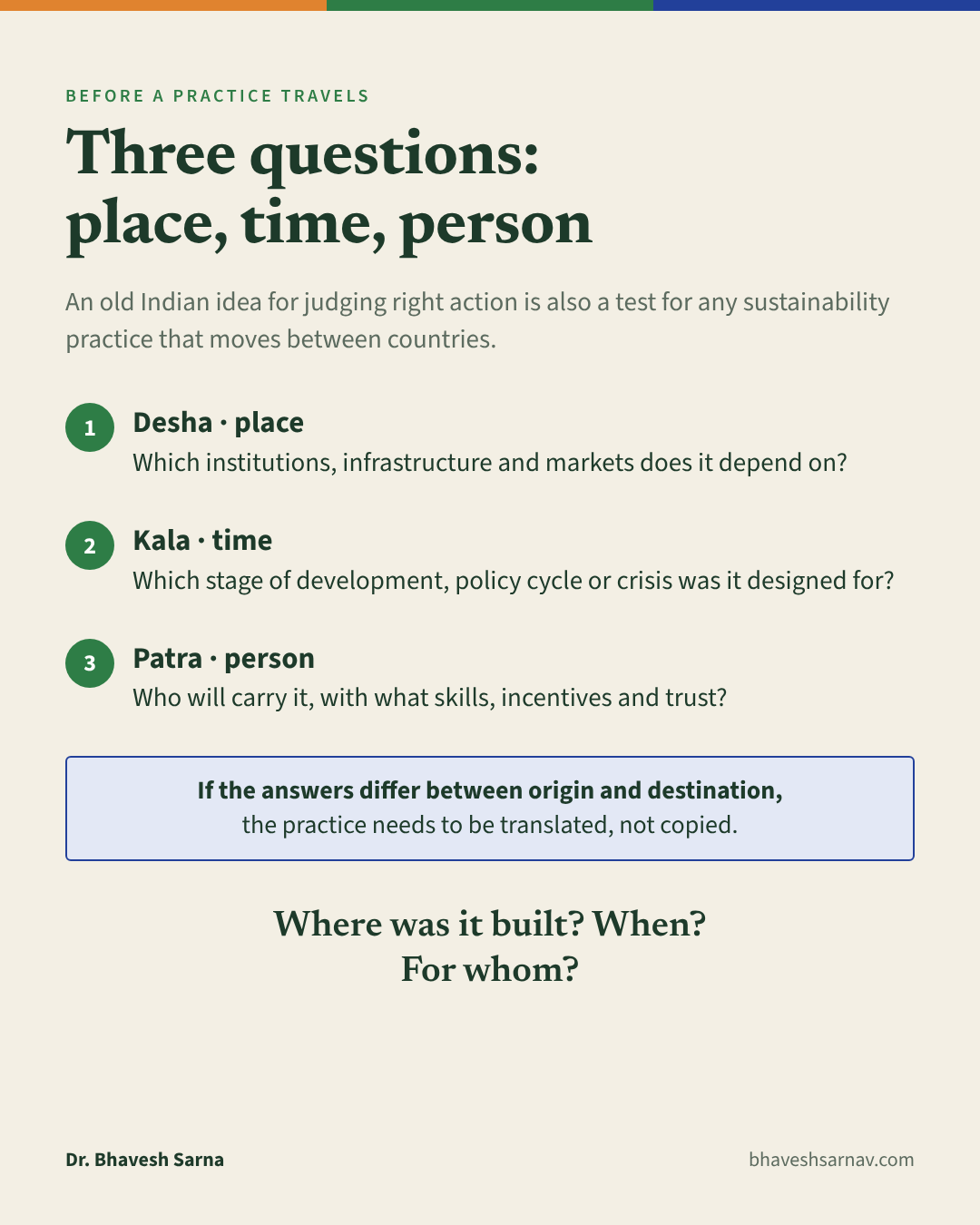
Desha: what does the practice depend on?
Every sustainability practice quietly depends on its place. It assumes certain institutions, infrastructure and markets.
Take extended producer responsibility for electronics. In Europe, it works through formal collection points, registered recyclers and reliable reporting. In India, a large share of e-waste flows through informal collectors and repairers, long before any formal system sees it. The same rule, applied in a different place, meets a different system.
The question to ask is not “does this work?” but “what does this need around it in order to work?“
Kala: when was it designed, and for what moment?
Practices are also shaped by their time. A policy designed for a rich country after decades of industrial growth assumes a certain stage of development. A business model designed when capital was cheap assumes certain interest rates. A reporting rule designed in a period of political enthusiasm may not survive a period of backlash, as Europe’s recent Omnibus reform shows.
India and Finland are at very different moments. Finland is ageing, wealthy and focused on keeping what it has built. India is young, growing fast and still building much of its infrastructure. A practice that fits one moment may simply be early, or late, for the other.
The question here is: which moment was this practice designed for, and is the destination in that moment now?
Patra: who will actually carry it?
The third condition is the one most often forgotten. A practice is carried by people: managers, workers, officials, students, small business owners. Their skills, incentives and trust decide whether it lives or dies.
A carbon accounting tool designed for a corporate sustainability team will struggle in a family-owned factory where the owner does every job. A participatory planning method that relies on high public trust will struggle where people expect officials to ignore them. The practice may be good. The vessel is different.
So the third question is: who will carry this practice, and is it designed for them?
From copying to translation
When the answers to these three questions are the same in both places, a practice can travel almost unchanged. When they differ, copying fails. What is needed instead is translation: keeping the purpose of the practice while rebuilding its form for the new place, time and people.
Translation is slower than copying, and less glamorous. It requires people who understand both contexts well enough to see what is essential and what is only local habit. It also requires humility from both sides. European partners must accept that their solutions are not universal. Indian partners must be clear about their own conditions instead of hoping an imported model will fix them.
I see this every year in international projects. The most successful moments are rarely when a polished European method is presented. They come when participants from different countries stop and ask, “how would this actually work where I live?”
A tool anyone can use
Desha, kala, patra is not only for scholars of Indian philosophy. It is a practical checklist. Before you adopt a policy, a business model or a teaching method from another country, ask three questions: Where was it built? When was it built? For whom was it built?
If the answers match your situation, go ahead. If they do not, do not throw the idea away. Translate it.
I would like to hear from readers who work across countries: which imported practice have you seen fail because one of these three conditions was ignored?