Regulation
CBAM meets the India–EU trade deal: the carbon data problem for small steel exporters
The trade deal opened Europe's door to Indian steel. The carbon border tax decides who can walk through it, and for small firms, the barrier is data, not only price.
This year, two big changes arrived at Europe’s border for Indian steel at almost the same time.
On 1 January, the EU’s Carbon Border Adjustment Mechanism (CBAM) moved into its full phase. Importers of steel, aluminium and some other goods now carry a cost for the carbon embedded in what they buy.
On 27 January, after nearly twenty years of talks, India and the EU concluded their free trade agreement. India’s commerce ministry confirmed that the agreement gives India no exemption from CBAM.
So the trade deal opens a door, and the carbon border tax stands in it. Large Indian steel makers have the teams and the money to deal with this. For small and medium exporters, it is a much harder problem. And in my view, the hardest part is not the price of carbon. It is the data.
Why data, not price, is the first barrier
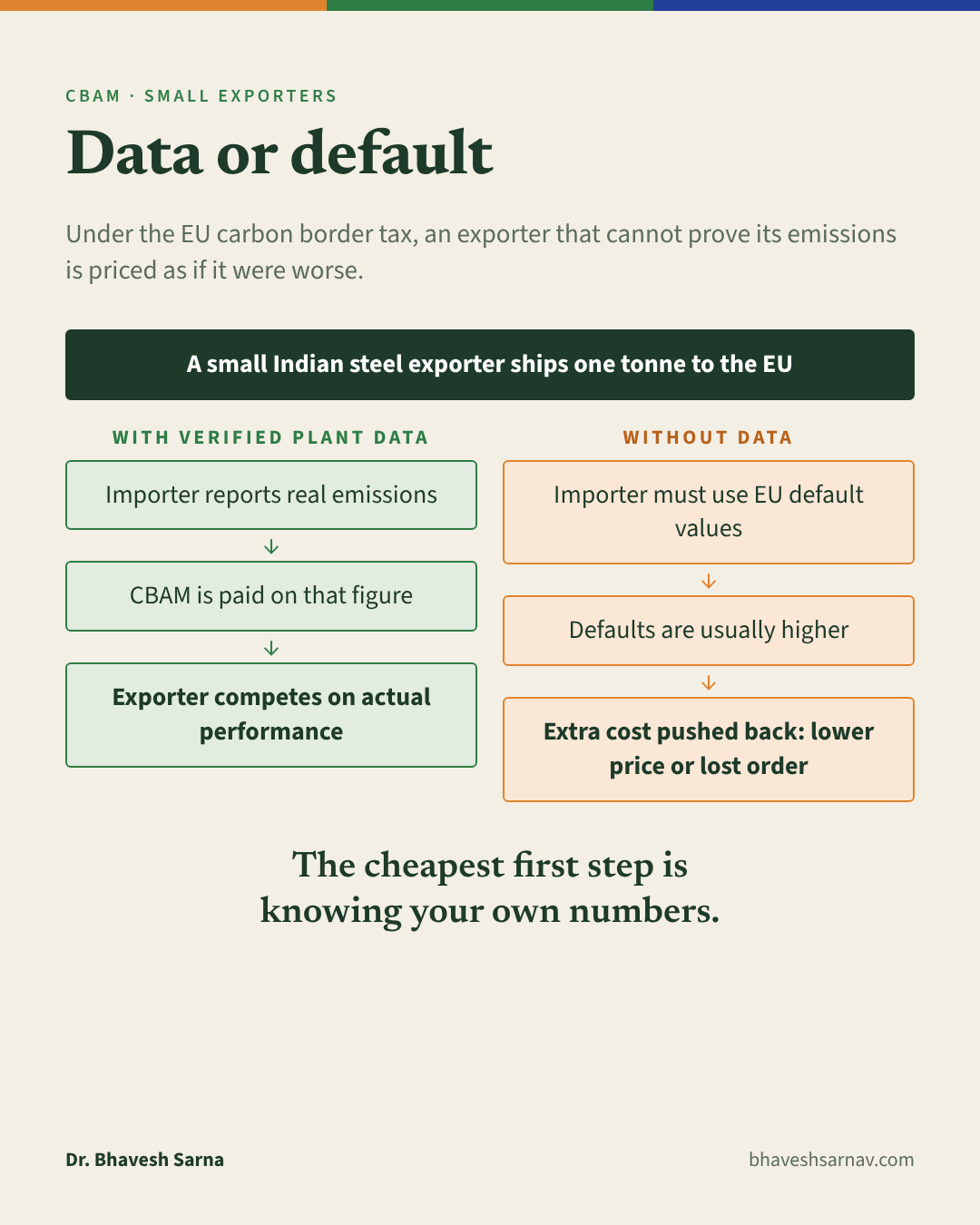
Under CBAM, the European importer must report the emissions embedded in each product it brings in. It gets that number from the supplier. If the supplier cannot provide verified data, the importer must use default values set by the EU. These defaults are designed to be cautious, which usually means higher than the real figure for a well-run plant.
The logic is simple. If you cannot prove your emissions, you are assumed to be worse than you probably are. And the higher cost is then pushed back to you through price. According to estimates reported by Vision IAS, importers may pass 50–70% of their CBAM costs back to exporters.
Reports from early this year describe small Indian steel exporters struggling with exactly this. The lack of reliable carbon data across supply chains is named as a major hurdle.
Why small firms find this so hard
Before I moved into sustainability research, I spent years in human resources, including managing the HR function of a steel plant in India. That experience taught me something that is easy to miss from a policy office in Brussels or Delhi: on a shop floor, data exists only when someone is responsible for it.
A large integrated steel maker has energy managers, environment teams and IT systems. A small re-rolling mill or forging unit often has none of these. Fuel bills sit with accounts. Electricity data sits with maintenance. Scrap and pig iron are bought from different traders, and nobody tracks where their emissions came from. The owner knows the business well, but not in tonnes of CO2.
Then there is the supply chain. Much of the carbon in a small mill’s product comes from the materials it buys, such as billets, sponge iron or pig iron. To report properly, the mill needs data from its own suppliers, who are often even smaller.
Finally, there is verification. CBAM data must be checked by accredited verifiers. That costs money and time, which a small exporter must spend before it knows whether the European order will continue.
The trade deal helps, but only partly
The trade agreement brings real benefits. India can export up to 1.64 million tonnes of steel a year to the EU under a preferential quota. The agreement also includes cooperation on carbon measurement and support for smaller exporters.
But the quota is shared, and the most profitable products tend to use it first. At the same time, the EU is tightening its steel safeguards and has proposed extending CBAM to many downstream products, such as parts and components. For small Indian firms, the pressure is rising from several sides at once.
What small exporters can do now
The good news is that the first steps are not expensive. They are mostly about organisation.
- Name one person. Give one person in the firm clear responsibility for energy and emissions data. Without an owner, nothing else works.
- Start with the bills you already have. Electricity, coal, gas, diesel and furnace oil are the core of most small plants’ direct emissions. Twelve months of bills, organised by month and process, is already a strong start.
- Ask your suppliers early. Tell your billet and sponge iron suppliers that you will need their emissions data. Choose suppliers who can provide it, even at a small premium.
- Work as a cluster. Industry associations in steel clusters can share the cost of training, software and verification. Many small firms facing the same problem can buy help together at a much lower price.
- Link it to India’s own carbon market. India’s carbon credit trading scheme is building its own monitoring and reporting systems. Data prepared for CBAM will also be useful there, and the reverse.
A cost today, an advantage tomorrow
It is easy to see CBAM only as a tax on Indian exports. It is that. But it is also a sorting mechanism. Exporters who can show credible, low emissions will find buyers who value them. Those who cannot will be priced as if they were the worst in their class.
For India’s small steel firms, the first and cheapest step towards competing in Europe is not a new furnace. It is knowing their own numbers.
If you work with small exporters, I would like to hear your view: what is the biggest practical obstacle to getting verified carbon data from small plants?