Circular economy
Industrial symbiosis: what Indian industrial clusters can learn from Finland
One factory's waste can be another's raw material. Finland built a national system to find these matches. India's industrial clusters, now under carbon pressure, could do the same.
Imagine a cement plant that buys the ash from a nearby power station, a greenhouse that runs on a factory’s waste heat, and a fish farm that uses warm cooling water from a power plant. Each company saves money. Together they use fewer raw materials and produce less waste.
This is industrial symbiosis: companies sharing waste, by-products, energy, water and infrastructure, so that one firm’s waste becomes another’s resource. It is one of the oldest and most practical ideas in the circular economy.
In this post I look at how Finland has organised industrial symbiosis, and what India’s industrial clusters could learn from it, especially now that India’s new carbon market is putting a price on industrial emissions.
The classic example
The most famous case is in Kalundborg, a small town in Denmark. Starting in the 1970s, a power station, a refinery, a pharmaceutical company, a plasterboard maker and the town itself began exchanging steam, water, gypsum and other flows. Nobody designed it as a grand plan. It grew one deal at a time, because each exchange made economic sense.
Kalundborg showed that symbiosis is not charity. It works because it saves money for everyone involved.
How Finland made it systematic
Finland took the idea a step further. Instead of waiting for matches to happen by chance, it built a national system to find them.
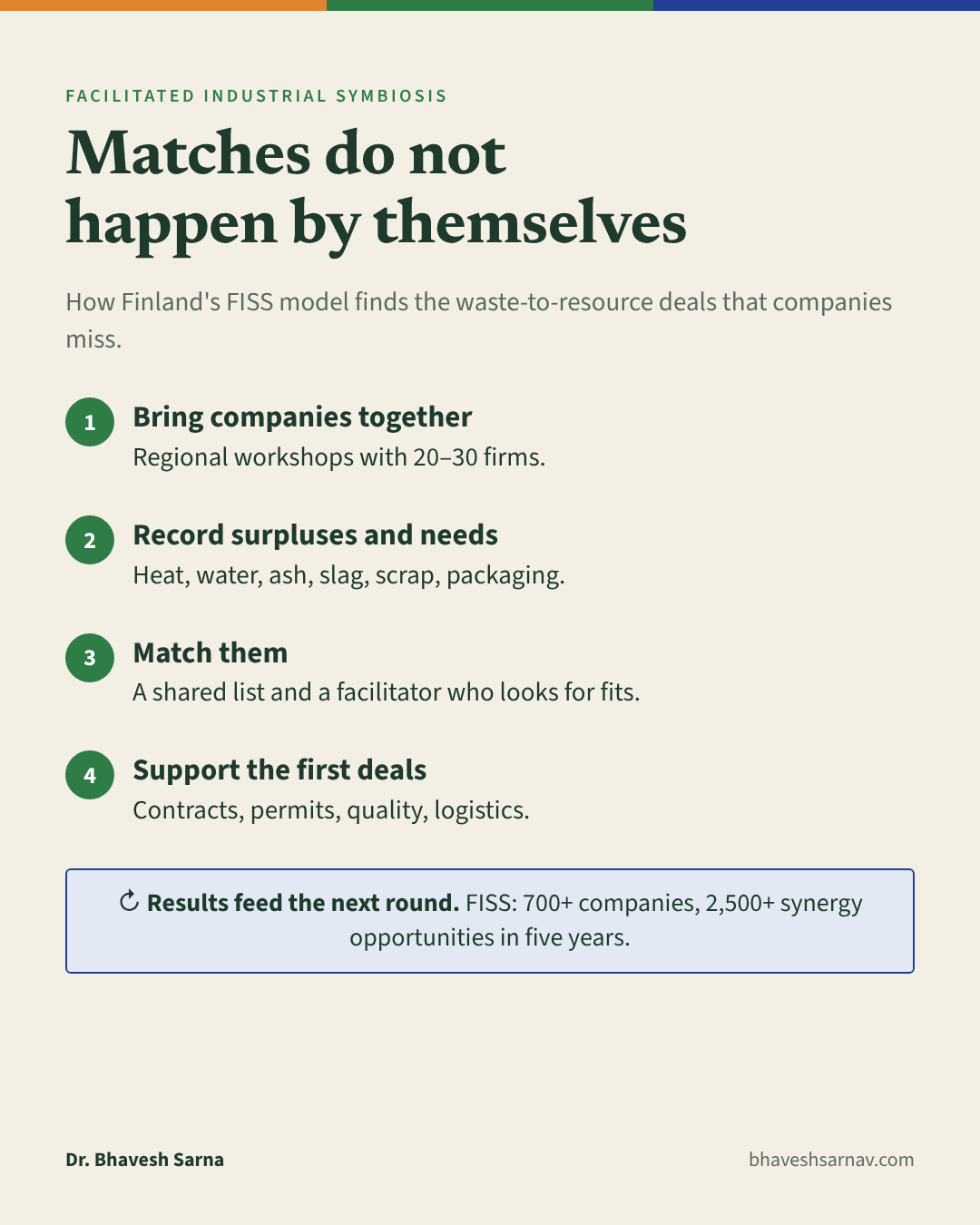
The Finnish Industrial Symbiosis System (FISS), coordinated by Motiva with funding from the Ministry of the Environment, works through regional organisers. They run workshops where companies list the resources they have in surplus and the resources they need. These are stored in a shared database, and facilitators look for matches. The method was adapted from the UK’s National Industrial Symbiosis Programme.
In its first five years, FISS ran more than 30 workshops in 14 regions, involved over 700 companies, registered more than 5,000 resources and identified over 2,500 synergy opportunities (Interreg Europe).
The lesson is simple: matches do not happen by themselves. Companies rarely know what their neighbours throw away. Someone has to bring them together, collect the information and help with the first steps.
Why this matters for India now
India already practises a lot of symbiosis, often without calling it that.
Fly ash from coal power plants goes into cement and bricks, and Indian rules now require power plants to find uses for all their ash. Steel slag is used in cement and road building. Scrap metal, paper and plastic move through huge informal recycling networks.
What India has less of is systematic facilitation: an organised way to find the matches that nobody has spotted yet, especially between smaller firms.
Three developments make this the right moment.
1. Carbon now has a price. India’s carbon market covers eight energy-intensive sectors, from cement and aluminium to textiles and refineries. Plants that cut their emissions intensity can earn and sell credits. Using a neighbour’s waste heat or replacing virgin raw materials with by-products can reduce intensity directly. I explained how the market works in a recent post.
2. Industrial clusters are natural hubs. India has many clusters where similar firms sit close together: textiles in Tiruppur and Surat, ceramics in Morbi, foundries in Kolhapur and Rajkot, chemicals in Gujarat. Proximity is the most important condition for symbiosis. Short distances make exchanges cheap.
3. Buyers are asking. European buyers increasingly want to know about recycled content and emissions in what they buy. A cluster that can show organised reuse of materials and energy has a story to tell.
What a cluster programme could look like
Based on the Finnish model, an Indian cluster could start with modest steps.
- Appoint a facilitator. An industry association, a state agency or a university can play this role. The facilitator needs trust from local firms.
- Run resource workshops. Bring 20–30 firms together. Ask each to list three things they waste and three things they buy. The first matches often appear in the room.
- Build a simple shared list. It does not need expensive software at first. A well-kept spreadsheet with resource types, quantities and locations is enough to start.
- Help with the first deals. Many good matches fail because of practical obstacles: permits for moving waste, unclear quality, small volumes, or lack of transport. The facilitator’s job is to remove these obstacles.
- Measure and share results. Track tonnes reused, money saved and emissions avoided. Visible results bring more firms into the programme.
Learning in both directions
Finland’s strength is organisation. India’s strength is scale and an existing culture of reuse. A partnership that combines the two could be very powerful.
As always when ideas travel, the model will need adapting. Indian clusters have more small firms, more informal actors and different regulations. What works in a Finnish region of a few hundred companies will need to be redesigned for a cluster of several thousand. But the core lesson travels well: someone has to make the connections.
Industrial symbiosis has its own chapter in the free KODECET coursebook Foundations and Catalysts for Circular Economy, with more examples and the theory behind it.
I would like to hear from readers in Indian industry: what does your plant throw away that someone nearby could probably use?