Circular economy
After WCEF Gandhinagar: what Finland can, and cannot, teach India about the circular economy
Finnish circular solutions are strong, but they were built for Finnish conditions. Some will travel to India easily. Others need to be rebuilt, not copied.
In September, the World Circular Economy Forum came to Gandhinagar. It was the tenth edition of the forum, and the first held in India and in South Asia. Finland and India organised it together.
For someone who has lived between the two countries for more than a decade, this was a happy moment. Finland started this forum through Sitra. India is one of the fastest-growing economies in the world, and it will decide much of the future demand for materials. Bringing the two together makes sense.
The forum was part of a busy year. In March, India and Finland renewed their memorandum on environmental cooperation, with a focus on circular economy and climate work. In August, the India Circular Economy Forum in New Delhi prepared the ground, under the theme of harmonising value chains in a new India–EU trade era. At Gandhinagar, Finland’s environment minister Sari Multala said that practical business models can flow between both nations and help make sustainability profitable.
I agree with the goal. But now that the forum is over, I want to ask a practical question: which Finnish solutions will actually work in India, and which will not?
Why copying does not work
Finland has real strengths. It was one of the first countries with a national circular economy roadmap, back in 2016. Its industry has decades of experience with side streams, forest products and recycling. It has a deposit system for bottles and cans that works so well that most Finns do not think about it.
But every one of these strengths grew in Finnish conditions. Finland has a small, high-trust population, strong municipalities, formal waste systems, high labour costs and a cold climate. Its solutions are shaped by all of these.
India’s conditions are very different. Labour is cheaper than materials, so repair is common and often informal. Millions of people already work in collection, sorting and resale, mostly outside formal systems. Consumers are very price-sensitive. And state capacity varies hugely from one city to another.
This means a solution that works in Lahti may fail in Lucknow, not because it is a bad solution, but because it was designed for a different set of problems.
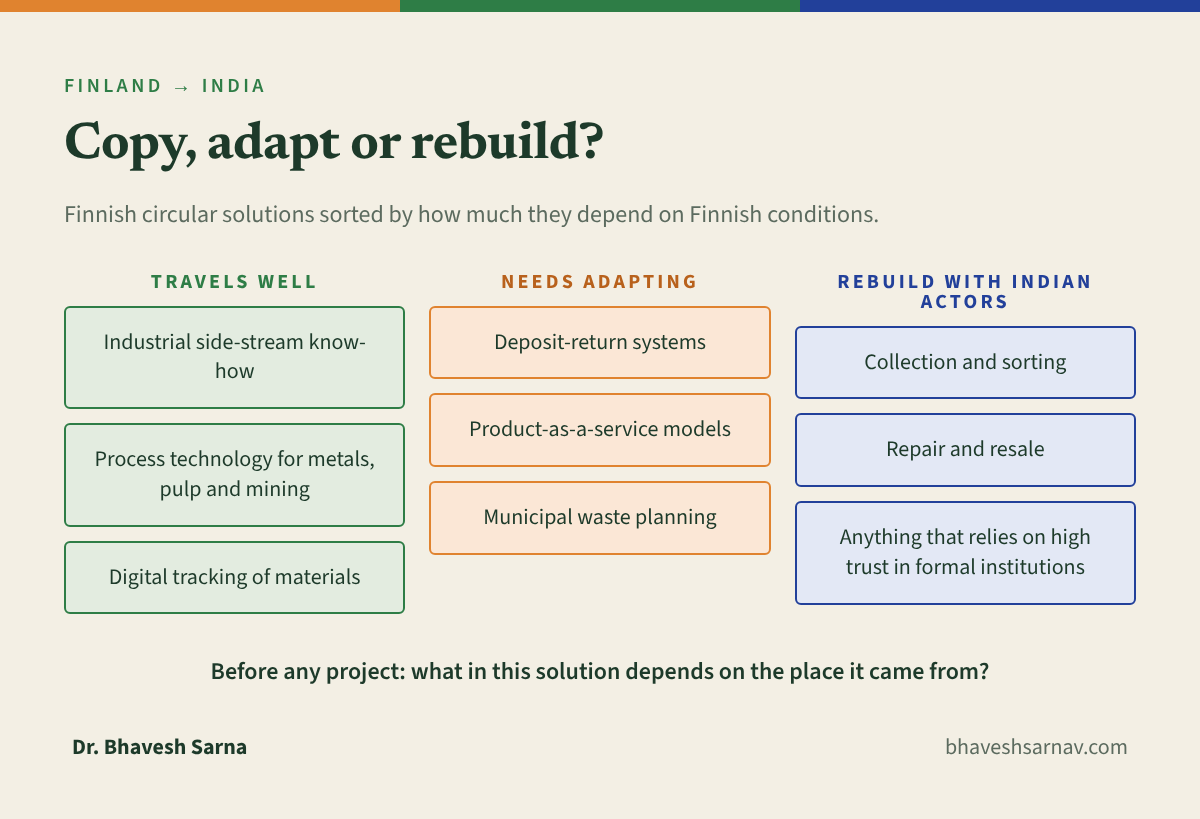
What travels well
Some Finnish strengths travel easily because they are about technology and industrial process.
- Industrial side streams. Finnish experience in turning slag, ash, sludge and other by-products into inputs is directly useful for Indian steel, cement, paper and mining. These are large, formal plants with engineers who speak the same technical language.
- Process technology. Finnish firms already sell equipment for recycling metals, treating water and processing minerals in India. Here the main barriers are price and financing, not context.
- Data and tracing. Tools that track materials across a value chain will matter more as European buyers ask Indian suppliers for proof. This is an area where Finnish and Indian digital strengths can meet.
What needs adapting
Other solutions can work, but only after real changes.
- Deposit-return systems. The idea is strong. But in India, informal collectors already pick up much of the valuable waste. A deposit system designed without them could take away their income. A better design would include them as paid partners.
- Product-as-a-service. Leasing phones, machines or furniture instead of selling them is a promising model. In India, it must work with very different credit systems, payment habits and expectations about ownership.
- Municipal planning. Finnish cities plan waste systems with stable budgets and long time horizons. Many Indian cities need models that start small, work with uncertain funds, and still deliver results quickly.
What must be rebuilt with Indian actors
Finally, some parts of the circular economy cannot be imported at all. They must be built in India, with Indian actors at the centre.
The best example is collection, sorting, repair and resale. India’s informal sector already runs one of the largest repair and reuse systems in the world. It is not perfect. Working conditions are often poor, and some recycling methods harm health and the environment. But it is efficient, and it is there. Any serious circular strategy for India must start by working with this system, not by replacing it with a European one.
This is also where I think Finland has the most to learn. India shows that circularity can be a daily economic habit, driven by need and skill, not only a policy goal.
Partnership, not transfer
The language of “knowledge transfer” suggests that knowledge flows one way. In circular economy, that is not true. Finland brings technology, planning experience and strong institutions. India brings scale, repair skills, frugal innovation and a huge informal network.
The partnership will work best when both sides ask the same question before any project starts: what in this solution depends on the place it came from?
I work on this question in my teaching and research projects across Finland, India and Thailand, and I will write more about it soon. In the meantime, I would like to hear from readers who were at Gandhinagar: what was the most promising India–Finland idea you saw there, and what would it need to work at scale?