Sustainability education
Teaching circular economy across Finland, India and Thailand: what I have learned
Nearly three years of KODECET taught me that circular economy cannot be taught as a European template. It has to be rebuilt in each classroom, with local examples and local teachers.
Two years ago I wrote about winning funding for KODECET, my first project as principal applicant. KODECET (Knowledge Development for Circular Economy Transition) is a €790,010 Erasmus+ capacity-building project. It brings together universities and partners in Finland, Austria, India and Thailand to build circular economy education in emerging economies.
The project is now close to its end. We have trained 27 professors from four universities in India and Thailand, written four circular economy books for students, and this October we ran an international student hackathon across the partner countries.
I promised then to share how the work went. This post is not a project report. It is a set of lessons I did not expect to learn when I wrote the application.
Lesson 1: the template is the problem
When we started, I assumed the main task was to adapt good European teaching material for Asian classrooms. Translate the examples, adjust the cases, and the rest would follow.
This was wrong. Most European circular economy material assumes a formal waste system, strong regulation, and consumers who can afford to choose sustainable options. Students in India and Thailand recognised the logic but not the world. Their reality includes informal recyclers, repair shops on every street, and small family firms that already reuse almost everything because they cannot afford waste.
In other words, many of our students already lived in a more circular economy than the textbooks described. The task was not to bring them circularity. It was to help them see, name and improve what was already there.
Lesson 2: teach the teachers first
Early on, we decided to put most of our effort into training professors rather than teaching students directly. This was the best decision in the project.
A visiting lecturer leaves after a week. A trained professor teaches the subject for years, adapts it every semester, and brings in local examples no outsider would know. The 27 professors we trained are now the real carriers of the project. Their courses will continue long after KODECET’s funding ends.
This also changed the direction of learning. In our training sessions, I often learned as much from the participants as they did from me. A professor from Gujarat or southern Thailand knows things about local industry, waste and markets that no European case study captures.
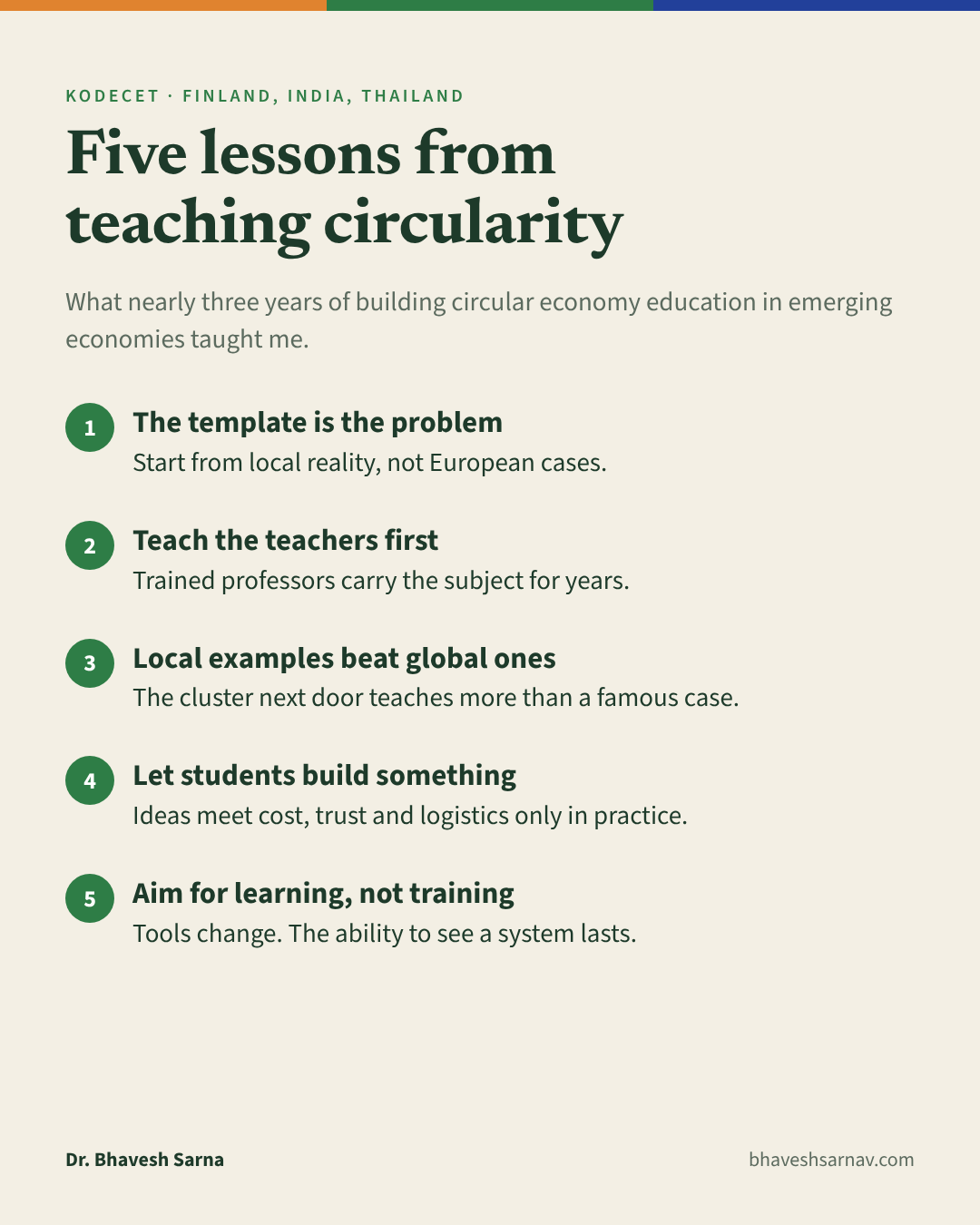
Lesson 3: local examples beat global ones
Students engage most when the case is close to home. A story about a Finnish forest company is interesting. A story about the textile cluster in their own state, or the e-waste market in their own city, is gripping.
So in our books and courses we moved steadily from global to local cases. Well-known European examples still have a place, as reference points. But the core of the teaching became problems students could visit, discuss with their families, or meet in their first job.
Lesson 4: let students build something
Lectures and reading lists give students the vocabulary of circular economy. They do not give them the experience of trying to make it work.
That is why the hackathon mattered. Student teams in India and Thailand worked on real circularity problems under time pressure, with mentors to guide them. Ideas that look easy on a slide, such as take-back schemes or product sharing, quickly run into real questions about cost, trust, logistics and who would pay. That is exactly the learning we wanted.
Running the same challenge in two countries also showed something a lecture cannot: the same solution works differently in each context. That realisation is hard to teach. It is easy to experience in a team.
Lesson 5: aim for learning, not training
I have a personal bias here. Earlier in life I left two MBA programmes within months, because they trained me for a job without teaching me to think. It was only later, in Auckland and then in Finland, that I found education that changed how I see the world.
Circular economy education faces the same choice. It is easy to train students in tools: life cycle assessment software, material flow templates, reporting standards. These skills matter. But tools change every few years. What lasts is the ability to see a system, ask who benefits and who pays, and imagine a better design.
In KODECET, we tried to give students both. Where we had to choose, we chose thinking over tools.
What comes next
KODECET’s formal funding ends soon, but the work does not. The professors we trained keep teaching. The books remain available. And the next projects build on what we learned: in 2027, I will lead a work package in MAPS, a new Erasmus+ project on smart and sustainable cities in South and Southeast Asia.
The most important lesson for me is simple. Circular economy is not a European product to be exported. It is a way of thinking that each place must rebuild for itself, with its own materials, skills and people.
In a follow-up post, I will share what happened at the hackathon itself: the problems students chose, the ideas that surprised me, and what I would change next time.
I would like to hear from other educators: what is the best local example you have used to teach circular economy, and why did it work?