Sustainability transitions
The hidden bill of change: reading Sitra's Megatrends 2026
Every change sends a bill. A new social contract needs to see which tensions today's decisions are quietly pushing into the future, and who will pay when they come due.
In January, Sitra published Megatrends 2026: Towards a new social contract. It is one of the most widely read foresight reports in Finland. It looks at four big changes: an ageing society, a changing world order, the environmental crisis, and artificial intelligence.
Its main message is simple. Many small fixes will not be enough. Finland needs a new social contract. Sitra describes this as a rethinking of how power, responsibilities and rights are distributed in society.
I read the report as a researcher in corporate sustainability. I also read it as someone who has lived between India and Finland for more than a decade. One question stayed with me after I finished it: what happens to the conflicts we do not settle?
Every change sends a bill
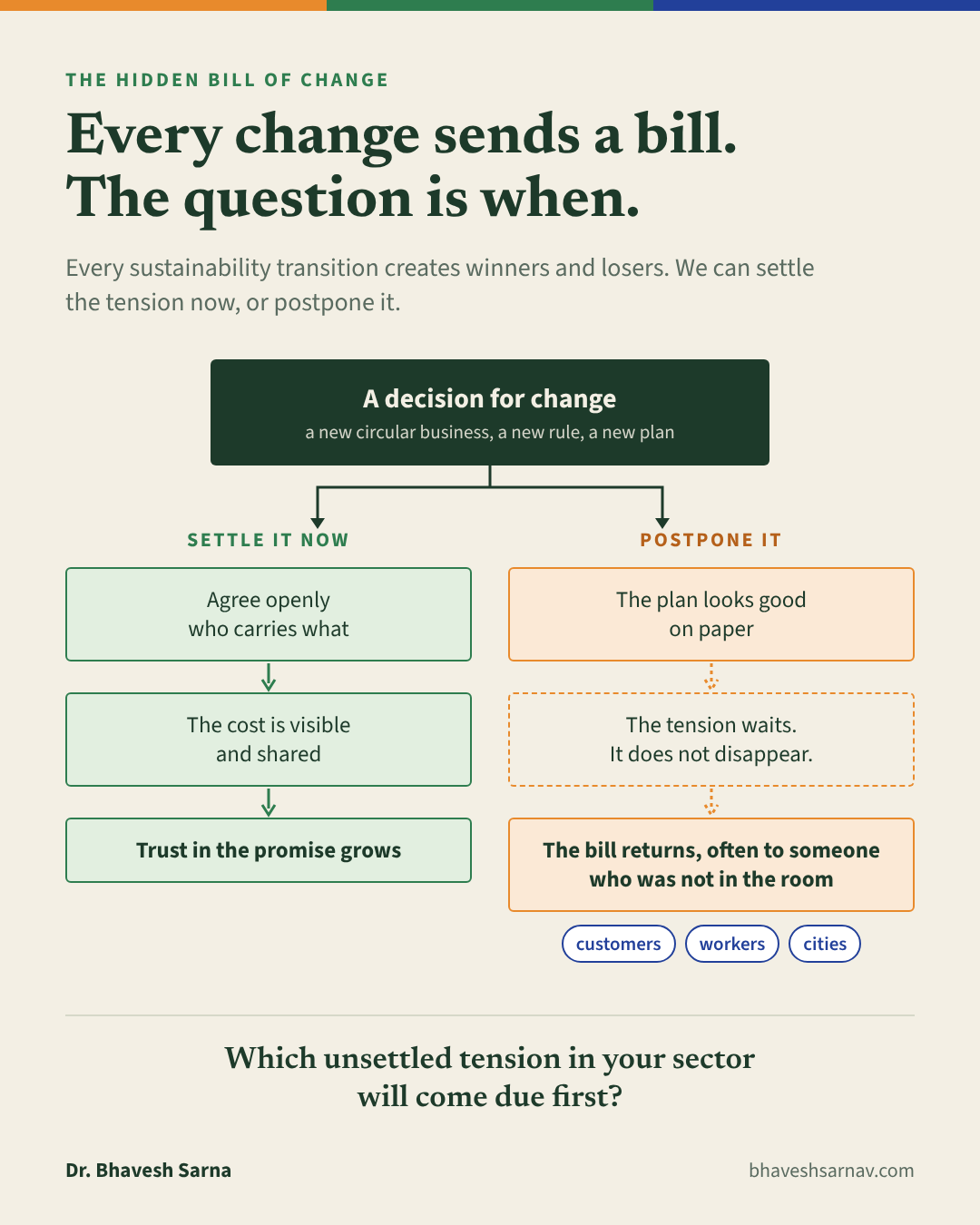
Every change creates winners and losers. A sustainability transition is no different. Someone pays more. Someone loses a job, a market or a habit. Someone carries a new risk.
There are two ways to deal with these tensions. We can settle them now, openly, and agree who carries what. Or we can postpone them.
Postponing is often the easier choice. It keeps a project moving. It makes a plan look good on paper. It avoids a hard meeting. But a postponed conflict does not disappear. It waits. And when it returns, it often lands on someone who was not in the room when the decision was made.
Sitra’s report comes close to this point. It notes that tensions around the sustainability transition are growing. It says that Finland’s ability to defuse simmering social conflicts through compromise will shape how well the country can build its future. That is an important message, and one that deserves more attention than it usually gets.
A small example from the circular economy
The circular economy is one of the big opportunities Sitra names for Finland, and I agree. But even good circular solutions carry open questions.
Think of a product that gets a second life: a phone, a laptop, a piece of furniture. It is collected, checked, priced and sold again. This is exactly the kind of activity we want more of.
Now ask a simple question. If that product fails early in its second life, who pays? The company that resold it? The customer who trusted it? Or, in the end, the city that has to deal with the waste?
Often, nobody has decided. The business works today, and the question is left for later. Multiply this by millions of products, and the open questions add up.
Why this matters for a social contract
A social contract is a promise about who gives what to whom. It only works if people believe the promise is fair.
Unsettled conflicts slowly eat into that belief. When the bill finally arrives, it often comes without warning, and it lands on those with the least power to refuse it: customers, workers, young people, or municipalities with thin budgets.
So if Finland wants a new social contract, it needs more than new promises. It also needs to see clearly which tensions today’s decisions are quietly pushing into the future.
What India and Europe can learn from each other
Countries have tried different ways to write business into the social contract.
India chose law. Since 2014, large companies in India must spend a share of their profits on social responsibility. The obligation is clear, but the harder question of how well the money is used often stays open.
Europe chose reporting. Companies must disclose their impacts and risks. Transparency is high, but the question of who acts on those risks often stays open too.
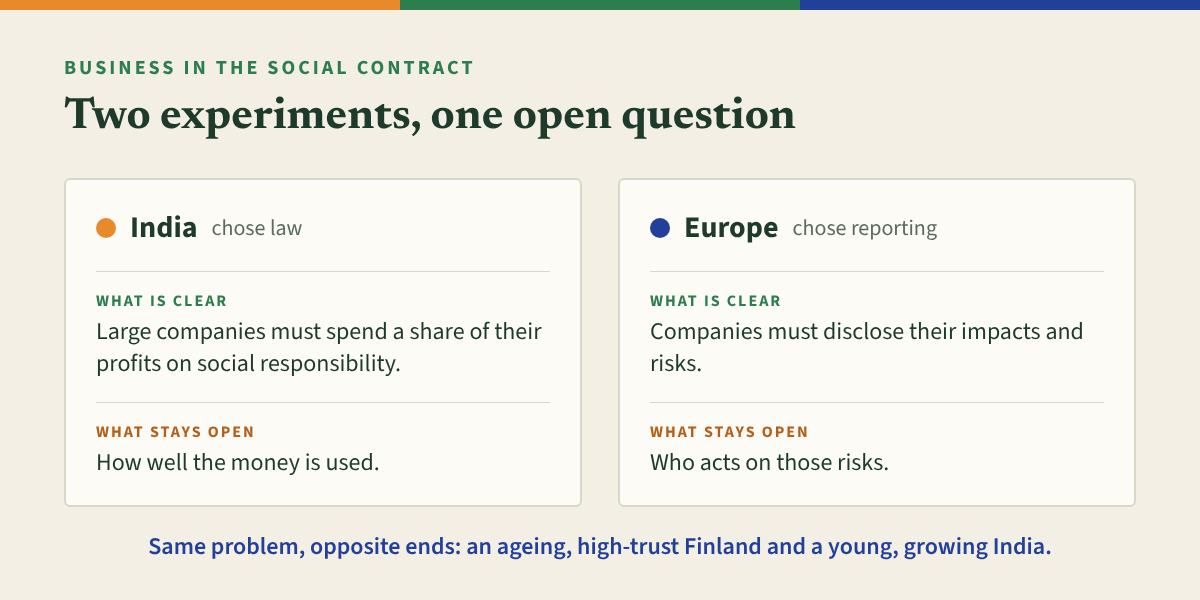
Neither model is complete. Both are large experiments. Finland, with its high trust and ageing population, and India, with its young and growing one, are looking at the same problem from opposite ends. Each has much to learn from the other, and I hope to see more of that conversation.
A question worth asking
The transition to a sustainable economy is necessary, and it is already happening. The question is not whether we change, but whether we are honest about who pays for the change, and when.
This is a question I am researching, especially in the circular economy. I would like to hear how you see it: which unsettled tension in your sector will come due first?