Life cycle assessment
Life cycle assessment for managers: what an LCA can and cannot tell you
An LCA can show where a product's environmental impact really sits. It cannot make your decision for you. Here is how to read one, and the five questions to ask before you trust it.
“Our new packaging has a 40% lower footprint, according to a life cycle assessment.”
Managers hear sentences like this all the time, from suppliers, consultants, marketing teams and competitors. Life cycle assessment (LCA) has become one of the main tools for making environmental claims. Yet many of the people who make decisions based on LCAs have never been shown how to read one.
I work with LCA in my research, and I teach it to business students. This post is the short introduction I wish more managers had: what an LCA is, what it is good for, where it can mislead, and five questions to ask before you trust one.
What an LCA is
A life cycle assessment measures the environmental impacts of a product or service across its whole life: from extracting raw materials, through manufacturing and transport, to use, and finally to disposal or recycling. People often call this “cradle to grave”.
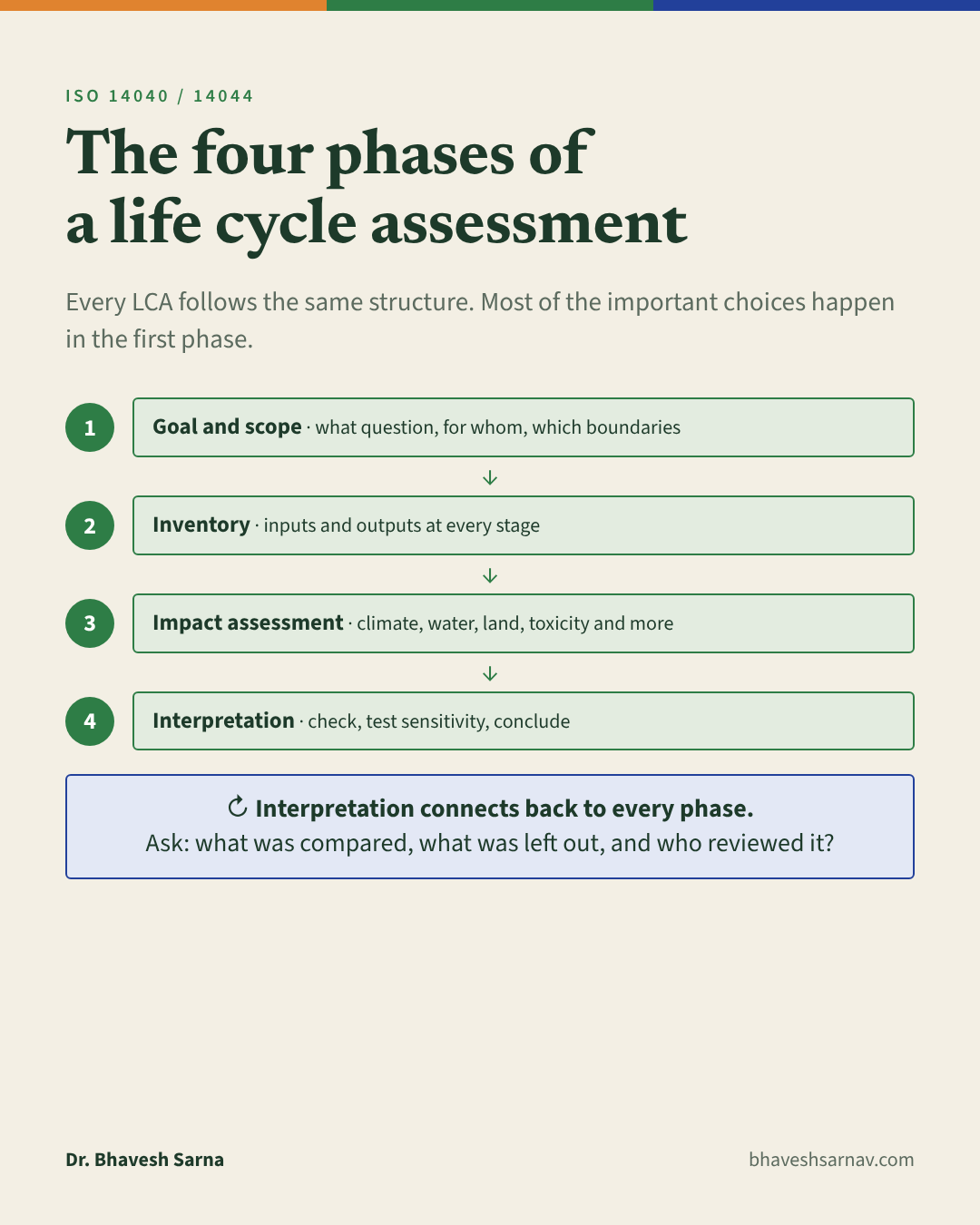
The method is standardised in two international standards, ISO 14040 and ISO 14044. They describe four phases.
- Goal and scope. What question are we answering, for whom, and where are the boundaries of the study?
- Inventory. Collect data on all the inputs (materials, energy, water) and outputs (emissions, waste) at each stage.
- Impact assessment. Translate those flows into environmental impacts, such as climate change, water use, acidification or land use.
- Interpretation. Check the results, test how sensitive they are to assumptions, and draw conclusions.
What an LCA is good for
Used well, LCA is one of the most useful tools a manager has.
It finds the hotspots. Many people assume the biggest impact of a product is in its packaging or transport. Often it is in raw materials or in the use phase. An LCA shows where the impact really sits, so effort goes where it matters.
It prevents burden shifting. Solving one problem can create another. A lighter material may reduce transport emissions but be harder to recycle. A product made in a cleaner factory may use more water. Because LCA looks at many impact categories across the whole life cycle, it reveals these trade-offs.
It supports better design. LCA is most powerful early, when a product is still being designed and choices are cheap to change.
It underpins credible claims. Environmental claims are under growing legal scrutiny. A claim backed by a well-documented LCA is far more defensible than one based on intuition.
Where an LCA can mislead
LCA is a model of reality, built on choices. Those choices can change the result completely.
Boundaries. A study that stops at the factory gate (“cradle to gate”) ignores use and disposal. For a washing machine or a car, that leaves out most of the impact.
The functional unit. LCA compares products based on the function they deliver, such as “packaging for one litre of milk” or “one year of laptop use”. If the functional unit is poorly chosen, the comparison is unfair. A cheap product that breaks twice as fast should be compared over the same service life.
Data quality. Many LCAs rely on average data from databases instead of the actual supplier. Average data may be from another country or another decade. The results are only as good as the data.
Impact choice. A study that reports only carbon may hide large impacts on water, land or toxicity.
Who paid for it. A study commissioned to support a marketing claim deserves extra scrutiny. ISO requires a critical review by independent experts for LCAs that compare products and are made public. Ask whether that review happened.
Five questions to ask before you trust an LCA
- What exactly was compared, and on what functional unit?
- What are the boundaries? What was left out?
- Where does the data come from, and is it specific or average?
- Which impact categories were assessed, and were any trade-offs found?
- Was it critically reviewed by someone independent?
If the people presenting the LCA can answer these questions clearly, you can probably rely on its conclusions. If they cannot, treat the headline number with care.
What LCA cannot do
Finally, it is worth being clear about the limits.
An LCA measures environmental impacts. It does not, on its own, tell you about the social impacts on workers and communities in the supply chain. For that, there is a separate method, social life cycle assessment, which I will introduce in tomorrow’s post.
And an LCA does not make your decision. It tells you about consequences. Weighing those consequences against cost, quality, customer needs and strategy is still the manager’s job. LCA makes that judgement better informed. It does not replace it.
If you want to go further, the free KODECET coursebook Foundations and Catalysts for Circular Economy has a full chapter on the role of life cycle assessment in the circular economy.
I would like to hear from managers: have you ever changed a decision because of what an LCA showed? What surprised you?