Research methods
Qualitative data analysis: a practical guide from my workshops
Most problems in qualitative analysis are not about software or theory. They come from a few common mistakes that are easy to avoid once you can see them.
I am often invited to run workshops on qualitative data analysis for doctoral researchers and early-career scholars, and I supervise doctoral students who work with interviews, documents and observations. Over the years, I have noticed that the same questions and the same mistakes come up again and again, whatever the topic or country.
This post collects the most useful advice in one place. It is written for doctoral researchers, master’s students writing a thesis, and anyone who has a pile of interview transcripts and is not sure what to do next.
First, know what analysis is for
Qualitative analysis is not about summarising what people said. It is about explaining something: a process, a meaning, a tension, a pattern. Your research question decides what that something is.
So before you code anything, write your research question on a piece of paper and keep it next to you. Every analytical decision should help answer it. If a code, theme or quote does not help, it can wait for another paper.
The process, step by step
There are many named approaches, such as thematic analysis, grounded theory, or the Gioia method common in management studies. They differ in important ways, and you should read about the one you choose. But most share a similar rhythm.
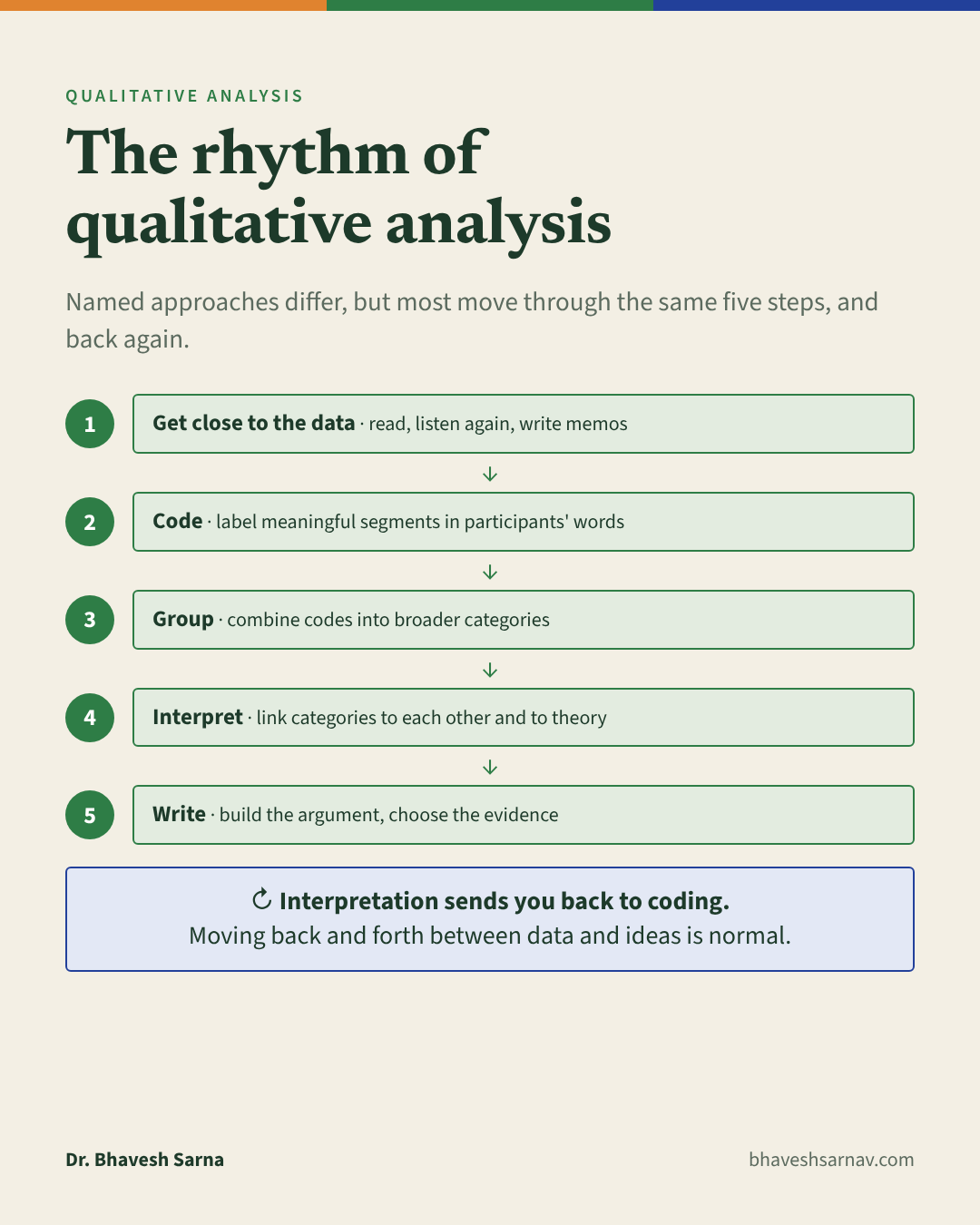
1. Get close to the data. Read every transcript at least once before coding. Listen to some recordings again. Write short memos about what surprises you. This step is often rushed, and it is where many of the best ideas begin.
2. Code. Label pieces of text that seem meaningful for your question. In the first round, stay close to the participants’ own words. Do not jump to theory too early.
3. Group. Bring related codes together into broader categories or themes. Ask what each group has in common and how it differs from the others.
4. Interpret. Now connect your categories to each other and to existing theory. What explains what? Where are the tensions? What is new compared with earlier studies?
5. Write. Build your argument, and choose the evidence that best supports each step of it.
These steps are not a straight line. Good analysis moves back and forth. Interpretation sends you back to the data, and new codes change your categories. That is normal, not a sign that something went wrong.
Seven common mistakes
These are the problems I see most often in workshops and in thesis drafts.
- Coding everything. New researchers often try to label every sentence. This produces hundreds of codes and no insight. Code what matters for your question.
- Themes that are just topics. “Motivation”, “barriers” and “challenges” are topics, not findings. A theme should say something: “managers frame sustainability as a cost they must justify” is a finding.
- Counting instead of explaining. Saying that twelve of twenty participants mentioned something is rarely the point. Qualitative research is strongest when it explains how and why.
- Quotes without analysis. A long quote followed by the next heading leaves the reader to do your work. Every quote needs your interpretation around it.
- Losing the research question. After months in the data, it is easy to drift. Return to your question often.
- Hiding the process. Reviewers want to see how you moved from data to findings. A clear table or figure showing codes, categories and themes builds trust.
- Treating software as analysis. NVivo, ATLAS.ti and MAXQDA are useful for organising data. They do not analyse it. Thinking happens in your memos, not in the software.
A word on AI tools
Many researchers now ask whether they can use AI to help code or summarise qualitative data. My advice is to be careful, for two reasons.
The first is ethics. Interview data often contains sensitive personal information, and participants agreed to specific uses of it. Before uploading any data to an AI tool, check your university’s rules and your ethics approval. Some universities do not allow it at all.
The second is quality. AI tools can produce smooth summaries that sound convincing but miss what matters: the hesitation, the contradiction, the unusual case. Those are often the heart of a good qualitative finding. If you use AI, use it as a sparring partner for your own ideas, not as a replacement for close reading.
Analysis is a craft
Qualitative analysis is learned by doing, not by reading about it. The first project always feels slow and messy. That is how it should feel. With each study, you become faster at seeing what matters and braver about interpreting it.
If you are early in your journey, I hope this guide saves you some time. And I would like to hear from experienced researchers too: what is the one piece of advice about qualitative analysis you wish you had received earlier?