Sustainability transitions
Doughnut economics in plain words, for managers
A doughnut has a hole in the middle and an outer edge. Kate Raworth used that simple shape to describe a safe space for humanity. It is also a surprisingly useful tool for business strategy.
Some of the most useful ideas in sustainability are also the simplest. Doughnut economics is one of them.
It was introduced by the British economist Kate Raworth, first in a 2012 Oxfam paper and then in her 2017 book Doughnut Economics. Since then it has been taken up by cities such as Amsterdam, by educators, and increasingly by companies. In the KODECET coursebook Foundations and Catalysts for Circular Economy, we gave it a full chapter, because students find it one of the clearest ways to think about what “sustainable” actually means.
This post explains the idea in plain words, and shows how managers can use it.
The shape
Picture a doughnut: a ring with a hole in the middle.
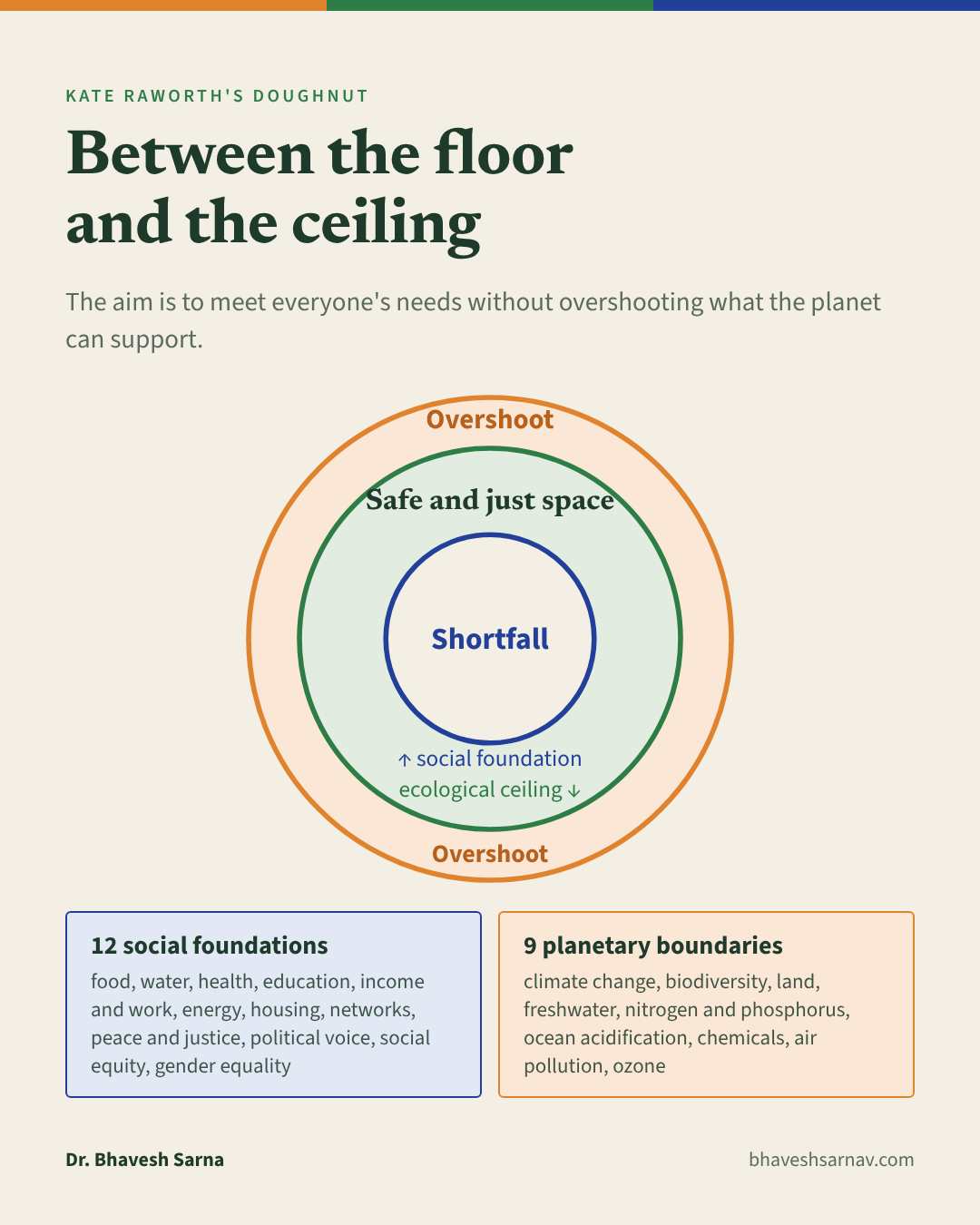
The inner edge is the social foundation. Below it, people lack the basics of a good life. Raworth lists twelve: food, water, health, education, income and work, energy, housing, networks, peace and justice, political voice, social equity and gender equality. Falling into the hole means human deprivation.
The outer edge is the ecological ceiling. Beyond it, we put too much pressure on the planet. Raworth uses the nine planetary boundaries defined by earth system scientists: climate change, biodiversity loss, land conversion, freshwater use, nitrogen and phosphorus pollution, ocean acidification, chemical pollution, air pollution and ozone depletion. Going past the outer edge means environmental overshoot.
The ring itself is the safe and just space. That is where humanity should aim to be: meeting everyone’s needs without overshooting what the planet can support.
Why the idea matters
The doughnut changes the question we ask about progress.
Traditional economic thinking measures success mainly by growth in output. The doughnut asks a different question: are we meeting people’s needs within the planet’s limits? Growth may help or hurt that goal, depending on what kind of growth it is.
The model also shows that the world currently fails on both edges at once. Many people still fall short on basics like food, energy and housing. At the same time, humanity has already overshot several planetary boundaries, including climate change and biodiversity. Solving one problem by worsening the other is not a solution.
What it means for a company
At first glance, the doughnut looks like a model for countries or cities. But it works surprisingly well as a lens for business. Here is how I use it with students and managers.
1. Map both edges. For your company, ask two questions. On the outer edge: which planetary boundaries do our products and operations push against? Carbon, water, land, chemicals? On the inner edge: which social foundations do we affect? Jobs and income, health and safety, access to energy or water, gender equality in our workforce and supply chain?
2. Look for shortfall as well as overshoot. Many sustainability strategies focus only on reducing harm. The doughnut reminds us that companies also contribute to meeting needs, through decent jobs, affordable products and essential services. Both matter.
3. Test new strategies against both edges. A circular business model that reduces material use but creates poor-quality jobs in collection and sorting may move you away from overshoot while moving people towards shortfall. A product that meets an important need but uses a lot of water may do the opposite. The doughnut makes these trade-offs visible.
4. Rethink what “success” means. A company aligned with the doughnut asks not only “are we growing?” but “are we helping people live well, within limits?” This can open new strategic options, such as designing for longevity, sharing and repair, or serving needs that markets have ignored.
Links to the circular economy
The doughnut and the circular economy fit together naturally.
The circular economy is mainly about the outer edge: keeping materials in use, reducing waste and lowering pressure on natural resources. The doughnut adds the inner edge: a reminder that a circular economy should also be a fair one.
This matters a great deal in countries like India, where much of the repair, reuse and recycling work is done by informal workers. A circular strategy that respects both edges asks how to keep materials in use and also how to make that work safer and better paid.
A simple but demanding idea
The doughnut is easy to draw and hard to live up to. It does not give you a formula. It gives you a picture that makes it difficult to ignore half of the problem.
For managers, that is its value. It turns sustainability from a list of separate issues into one question: is our business helping to bring people into the safe and just space, or pushing them out of it?
The KODECET coursebook is free to download if you want to read the full chapter: Foundations and Catalysts for Circular Economy.
I would like to hear from readers: if you drew a doughnut for your own organisation, where would it overshoot, and where would it fall short?