AI and sustainability
AI washing: when companies oversell AI for sustainability
After greenwashing comes AI washing: big claims that artificial intelligence is cutting emissions or waste, with little to show how. Five questions help separate real gains from marketing.
Read a few recent sustainability reports and press releases, and a new kind of sentence appears again and again. “AI-powered energy optimisation.” “Machine learning reduced our waste by 30%.” “Our AI platform makes supply chains sustainable.”
Some of these claims are true and impressive. Artificial intelligence can genuinely help companies use less energy, plan logistics better, predict machine failures and track materials. I am optimistic about many of these uses, and AI for sustainability is one of the areas I work on.
But some claims are much bigger than the reality behind them. The term for this is AI washing: presenting a product, process or achievement as driven by AI, or as more advanced than it is, to look innovative or responsible.
When AI washing meets sustainability claims, two hype cycles reinforce each other. That deserves a closer look.
AI washing is already a regulatory issue
This is not only an academic worry. In March 2024, the US Securities and Exchange Commission settled charges against two investment advisers for making false and misleading statements about their use of AI. It was one of the first enforcement actions to use the idea of AI washing directly, and regulators have continued to warn about it since.
Sustainability claims are also under closer watch than ever. Many countries now treat vague or unproven environmental claims as misleading. A claim that combines both, such as “our AI cut emissions by half”, sits at the meeting point of two areas of rising scrutiny.
Why AI washing is hard to spot
Greenwashing can often be checked against physical facts. Did emissions fall? Was the material really recycled? These questions are hard, but at least they have measurable answers.
AI claims are harder. AI is a broad label that can mean anything from a simple statistical model to a large, complex system. Outsiders usually cannot see what the system does, what data it uses, or how much of the result came from the AI and how much from ordinary management decisions made at the same time.
So a company can truthfully say it “used AI” while the AI played only a small part. It can report a large saving without saying that most of it came from new equipment or a quieter production year. And it rarely mentions the energy and water that the AI itself consumes.
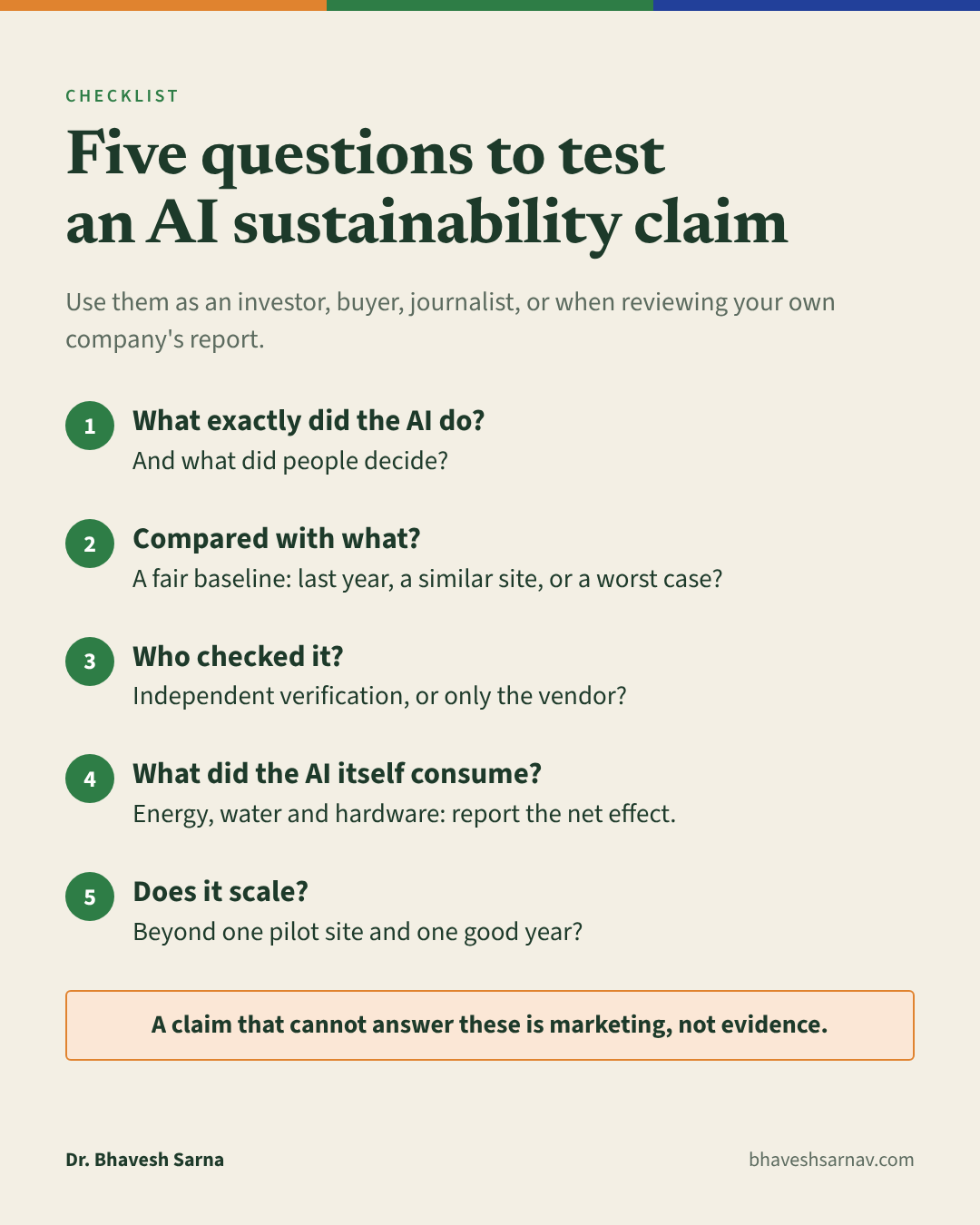
Five questions to test an AI sustainability claim
Whether you are an investor, a journalist, a buyer or a manager reviewing your own company’s report, these five questions help.
1. What exactly did the AI do? A good claim separates the AI’s role from human decisions. “The model forecasts heating demand, and operators use the forecast to schedule boilers” is clear. “AI transformed our operations” is not.
2. Compared with what? Any saving needs a baseline. Was the 30% reduction measured against last year, against a similar site without AI, or against a worst case? Without a fair baseline, the number means very little.
3. Who checked it? Was the result verified by someone independent, or only by the team that sold or built the system? Vendor case studies are not evidence.
4. What did the AI itself consume? Training and running AI systems uses electricity, water and hardware. For small savings, the footprint of the AI can cancel out much of the gain. An honest claim reports the net effect.
5. Does it scale? Many impressive results come from a single pilot site, a short period or ideal conditions. Ask whether the result has held across sites and over time.
A claim that answers these questions clearly is probably real. A claim that avoids them is probably marketing.
Why this matters for companies
For companies, the temptation to oversell is understandable. Investors reward both AI and sustainability stories, and combining them is attractive.
But the risks are growing. Overstated claims can lead to regulatory action and reputational damage. They can also damage the company internally. Employees who see the gap between what is announced and what actually happens often lose trust in both the AI project and the sustainability strategy. Real progress then becomes harder.
The better path is simple, if less exciting: describe what the AI actually does, measure its effect fairly, report its own footprint, and let the results speak.
Honest AI is good AI
I believe AI can make a real contribution to sustainability. That is exactly why AI washing worries me. Every inflated claim makes it harder to trust the real successes, and harder for good projects to get attention and funding.
I would like to hear from readers who work with AI in sustainability: what is the most convincing AI sustainability result you have seen, and what made it convincing?