CSR
The emotional side of corporate sustainability work
Sustainability strategies are written in the language of targets and reports. They are lived in the language of pride, frustration, guilt and hope. Companies that ignore this lose the people they need most.
Most writing about corporate sustainability is calm and technical. It speaks of targets, metrics, standards and reports. Read a sustainability report and you will rarely find a feeling in it.
But talk to the people who do sustainability work inside companies, and the conversation changes quickly. They speak of pride when a project succeeds. Frustration when a good proposal is shelved. Guilt when they defend a decision they do not believe in. Hope, sometimes, and tiredness, often.
My doctoral research at the University of Jyväskylä looked at exactly this: how employees relate to their company’s sustainability and social responsibility, and how they make sense of the difficult moments. In this post I share what I learned, in plain language, and why I think it matters for managers.
Where the tension comes from
Sustainability work is full of built-in tension. A few examples will be familiar to anyone who has done it.
- An employee believes deeply in climate action, but the company’s main product is carbon-intensive.
- A sustainability manager writes an ambitious report, knowing that some of the plans in it have no budget.
- A purchasing team is asked to choose responsible suppliers, but is measured mainly on price.
- An engineer proposes a cleaner process, and it is rejected because the payback period is one year too long.
In each case, the person sits between what they value and what the organisation does. That gap does not stay on paper. It is felt.
How people make sense of it
In a study I published with my colleagues Tiina Onkila and Marileena Mäkelä in the Social Responsibility Journal (2022), we looked at how employees made sense of emotionally tense experiences connected to their organisation’s sustainability. The title of the article asks the question directly: Rationality, experiences or identity work?
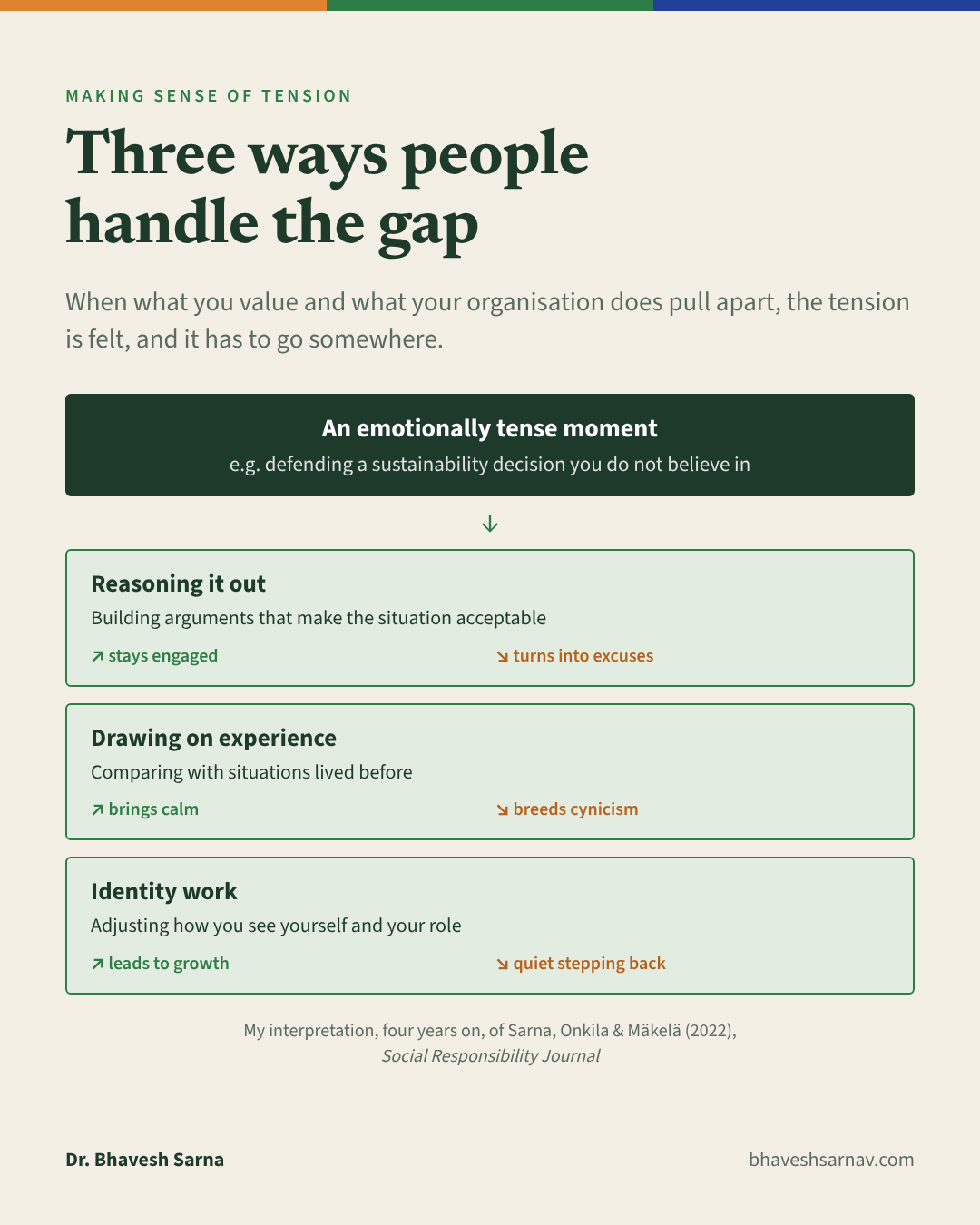
Looking back at that paper four years after it was published, this is how I interpret it in practical terms: people do not handle these tensions in one way. Some reason their way through them, building arguments that make the situation acceptable. Some draw on their past experiences, comparing this moment with others they have lived through. And some work on their own identity, adjusting how they see themselves and their role so that they can live with the gap.
None of these is right or wrong. But each has consequences. Reasoning can help a person stay engaged, or it can slowly turn into excuses. Experience can bring calm, or cynicism. Identity work can help someone grow, or it can lead them to quietly step back from sustainability work altogether.
Why managers should care
It is tempting for organisations to treat emotions as private matters, outside the scope of strategy. I think this is a mistake, for three reasons.
Emotions are information. When employees feel frustration or guilt about sustainability, they are often pointing at a real gap between what the company says and what it does. That gap is a risk. It may later appear as a greenwashing accusation, a lost talent, or a failed transition plan. Listening early is cheaper.
The most committed people are the most exposed. Employees who care most about sustainability are the ones who feel the tensions most strongly. If the organisation offers them no space to deal with these feelings, they are also the ones most likely to burn out or leave. Companies lose exactly the people they need for the transition.
Silence is not neutral. When tensions cannot be discussed, people deal with them alone. Some will find healthy ways. Others will slowly disengage. Neither shows up in a sustainability report, but both shape what the company can achieve.
What organisations can do
There is no simple tool for this, but a few practices help.
- Name the trade-offs openly. Most tension comes from situations where values compete. Saying this openly, instead of presenting sustainability as a win-win in every case, makes the work more honest and less lonely.
- Create spaces to talk. Team discussions, reflection sessions or simply honest one-to-one conversations give people a way to work through difficult decisions together.
- Involve people in the hard choices. Employees accept difficult decisions more easily when they understand how they were made and had a chance to speak.
- Watch for quiet withdrawal. A committed person who suddenly stops proposing ideas may not have lost interest. They may have lost hope that anything will change.
Sustainability is human work
Regulation, reporting and technology all matter for the sustainability transition. But in the end, the work is done by people, inside organisations, every day. How they feel about that work, and how they make sense of its contradictions, will decide much of what is possible.
My research continues to build on these questions, now in new settings such as regulation and technological change at work. You can read my doctoral thesis for the full picture.
I would like to hear from people who work on sustainability inside organisations: what is the hardest tension you have had to live with in your role, and what helped you deal with it?