Doctoral supervision
Why I push my PhD students to do better than me
A PhD student is not a junior assistant. They are a colleague learning from someone a few steps ahead. That idea shapes everything about how I supervise.
I supervise several doctoral students. When I meet a new one, I tell them something that sometimes surprises them: I want their publications to be stronger than mine, right from the beginning.
Some take it as a polite exaggeration. It is not. It is the main principle behind how I supervise, and in this post I want to explain why, and what it looks like in practice.
A colleague, not an assistant
In many universities, doctoral students are treated as junior helpers. They collect data for their supervisor’s projects, write the parts nobody else wants to write, and wait their turn.
I see it differently. At the doctoral level, a student is a colleague learning from someone more senior. They are not there to serve my research. They are there to become independent researchers, and the sooner they do, the better.
This changes the relationship. A colleague can disagree with you. A colleague brings ideas you had not thought of. A colleague eventually knows more about their topic than you do, and that is exactly what should happen in a good PhD.
Why I want them to do better
There are three reasons.
The field moves forward through them. My own work builds on what my supervisors taught me. If my students only reach my level, the field stands still. If they go further, it moves.
The bar is higher now. Academic careers today are more competitive than when I started. Students need stronger publications earlier to win funding and positions. Aiming low at the start is a disadvantage they cannot afford.
Their success is the real measure of mine. A supervisor’s legacy is not their own CV. It is the researchers they leave behind.
What it looks like in practice
Principles are easy to state. Here is how I try to put this one into practice.
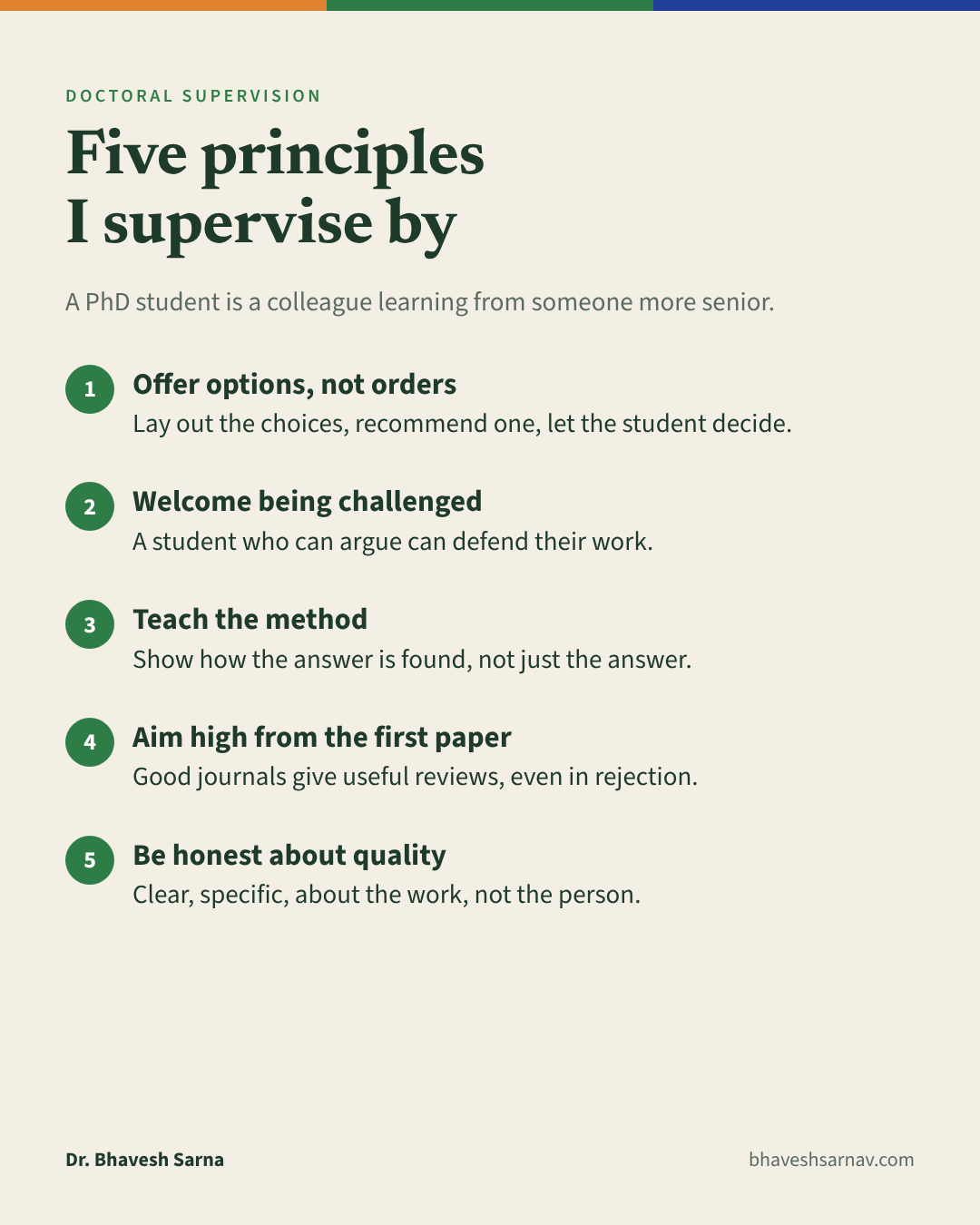
I offer options, not orders. When a student faces a decision, such as a method, a theory, a journal or a research design, I lay out the realistic options and what each would lead to. I recommend the one I think is best, and I explain why. Then I leave the decision to the student. It is their PhD, and they have to own it.
I welcome being challenged. Some of my best exchanges with students began with them saying “no, I don’t agree” to my face. A student who can argue with their supervisor, politely and with reasons, will be able to defend their work in front of reviewers and examiners.
I teach the method, not just the answer. It would often be faster for me to fix a paragraph or choose the right reference. But then the student learns nothing. I try to show how I arrive at an answer, so that next time they can find it themselves.
I aim high on journals. I encourage students to target strong journals from their first paper, even if it means more rejections. Rejections from good journals come with useful reviews. Easy acceptances teach very little.
I am honest about quality. Pushing someone to do better means telling them when their work is not good enough yet. I try to be clear and specific, and to separate the work from the person.
What I expect in return
This approach depends on effort from both sides. Freedom to decide comes with responsibility for the decision. I expect students to keep careful records of their methods and data, to meet the deadlines they agree to, and to come to meetings prepared.
When that works, supervision becomes one of the most rewarding parts of academic life. You watch someone grow from uncertainty to confidence, and eventually they teach you things.
Where this comes from
My own path into research was not straight. I studied engineering, worked in human resources for years, and left two MBA programmes because they trained me for a job without teaching me to think. It was only later, in Auckland and then in Finland, that I found education that changed how I see the world.
That experience left me with a strong belief: the purpose of education, at every level, is learning to think for yourself. A PhD is the highest form of that. My job as a supervisor is not to produce copies of myself. It is to help people become researchers who no longer need me.
I would like to hear from other supervisors and doctoral researchers: what is the single most useful thing a supervisor ever did for you?