Regulation
The West is easing its sustainability rules. India is starting to price carbon.
Simplification in Europe and the US does not make the carbon question go away for Indian business. It only changes where the bill is paid.
Last week brought two very different kinds of news.
In London, the UK’s financial regulator decided not to make climate reporting mandatory for listed companies. In Washington, the US government cut its fuel-economy target for new cars by almost a third. In Brussels, companies are now working with a much smaller set of EU reporting and due diligence rules after the Omnibus reforms.
In India, the story runs the other way. The country’s first compliance carbon market is preparing to issue carbon credits, and heavy industry now has legally binding emission targets.
Read quickly, the headlines say that the West is losing interest in sustainability rules. For an Indian manager, I think the more useful reading is different: the cost of carbon is not disappearing. It is moving.
What the West loosened, and what it kept
The direction in Europe and the US is clear. Rules are being cut back in the name of cost and competitiveness.
The EU’s Omnibus reform is the biggest example. Under the Corporate Sustainability Reporting Directive (CSRD), only EU companies with more than 1,000 employees and €450 million in turnover must now report. Law firm Dechert notes estimates that about 85% of companies have dropped out of scope. The due diligence directive (CSDDD) now starts in 2029, and the duty to adopt a climate transition plan has gone.
But look at what Europe did not touch. The Carbon Border Adjustment Mechanism (CBAM) moved into its full phase in January 2026. Importers of steel, aluminium, cement, fertiliser and some other goods are now liable for the carbon embedded in what they bring into the EU, and must buy certificates to cover it. Large non-EU groups with more than €450 million turnover in the EU will still report under CSRD from 2028, and that includes circularity and packaging.
In other words, Europe has eased the paperwork for its own companies. It has not eased the price of carbon at its border.
What India is building
While the West simplifies, India is putting a price on carbon for the first time.
The Carbon Credit Trading Scheme (CCTS) grows out of the older Perform, Achieve and Trade scheme for energy efficiency. About 490 plants in seven sectors (aluminium, cement, chlor-alkali, pulp and paper, refining, petrochemicals and textiles) now have legally binding targets to cut their emission intensity, measured against 2023-24 (ICAP). Draft targets for about 255 iron and steel plants followed in July, and fertiliser is still to come. Plants that beat their target earn carbon credit certificates. Plants that miss it must buy them. Trading will run on India’s power exchanges. The first credits are expected to be issued this month, with trading to follow.
The early targets are modest, and prices are expected to be low compared with Europe. That is normal for a new market. What matters is that a price now exists, and that it will rise as targets tighten.
The second piece is trade. The India–EU free trade agreement, concluded this year, includes a roadmap on CBAM. It gives India room to raise the carbon price already paid at home with EU authorities, and it promises help for small exporters with carbon measurement and verification.
Carbon will be paid somewhere
Put the two stories side by side and a simple logic appears.
For an Indian steel or aluminium exporter, the carbon in each tonne will be paid for. The only question is where. If India has no carbon price, the full cost is paid at the EU border, and the money goes to Europe. If India has a credible carbon price, part of that cost may be counted against CBAM, and that money stays in India, where it can fund cleaner power and better technology.
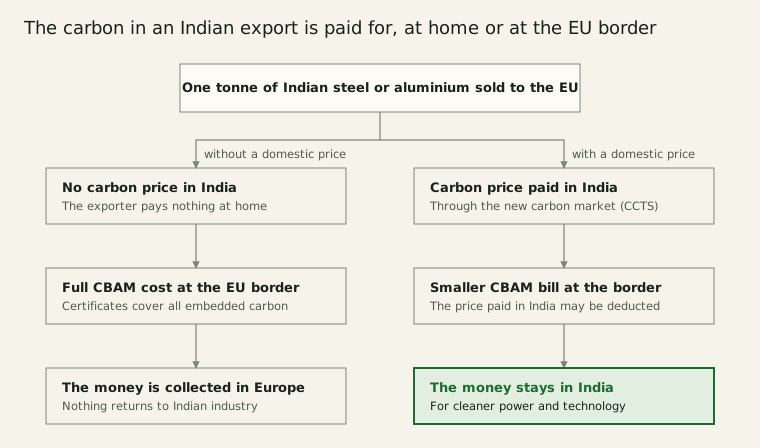
This is why I read India’s carbon market less as a climate gesture and more as an economic decision. It is a way to keep carbon money at home.
It also explains why European simplification should not make Indian firms relax. Most Indian companies were never in scope of CSRD in the first place. What reaches them is the border price, the questionnaires from European buyers, and now a domestic market. None of these were softened last week.
There is a wider point as well. Rules in Europe and the US are cut back when politics shifts. A carbon price that is built into trade and into a national market is much harder to reverse. For a company planning investments for the next ten years, that stability matters more than any single reporting rule.
What Indian firms should do now
The right response depends on where a company sits.
- If you are in a CCTS sector, treat your target as a business plan, not a compliance form. Every efficiency gain beyond the target becomes a credit you can sell. Start measuring at plant level now, before the first trading cycle sets the price.
- If you export to Europe, know the carbon content of your products. European importers need verified emissions data from you, and good data is now a commercial advantage. Without it, importers must use default values that are often higher.
- If you are a supplier to either group, expect questions about energy use, emissions and waste from your customers. Smaller firms can prepare with simple steps: an energy bill audit, a record of fuel use, and one person who owns the data.
For all three, the cheapest carbon is the one you never emit. Energy efficiency, renewable power and less material waste lower the cost under every rulebook, Indian or European.
A different kind of maturity
It is easy to read last week as a retreat from sustainability. I see it more as a sorting. Europe and the US are cutting rules that asked companies mainly to describe what they do. They are keeping, and in Europe’s case strengthening, rules that put a price on what companies emit.
India, alongside its BRSR reporting rules, has now chosen to build a carbon price. That is the harder and more lasting tool. If the market works, with honest data, rising targets and fair treatment for small firms, India will not only protect its exporters. It will show that a fast-growing economy can grow and price carbon at the same time.
The next few months, when the first credits are issued and traded, will show whether that promise holds. I will be watching closely.